


Your Volvo feels normal at idle, but when you press the accelerator it hesitates, feels flat, or suddenly has much less power. That symptom can come from something as simple as an intake leak or as serious as a powertrain fault that has put the car into reduced-performance mode.
Volvo loss of power when accelerating is not one single fault. The best diagnostic path depends on when the power disappears, what warning message is displayed, whether the engine is gasoline or diesel, and whether engine RPM rises normally while road speed does not.
This guide starts with the fastest checks, then separates boost, fuel, airflow, ignition, diesel-aftertreatment, transmission and hybrid-related causes so you can diagnose the symptom without throwing parts at the car.

QUICK ANSWERIf your Volvo loses power when accelerating, scan the car for stored codes first and note exactly when the power drops. A hissing sound or weak pull under boost points toward a charge-air/boost leak; misfiring or shaking points toward ignition or fueling; RPM rising without matching vehicle speed points more toward the transmission or clutch; and a diesel driven mostly on short trips may have a DPF/EGR issue. If the display says Reduced performance or Acceleration performance reduced, the car may have entered a protective limp-home mode and the underlying powertrain fault should be diagnosed rather than repeatedly cleared.
KEY TAKEAWAYS
- Scan before replacing parts: a code is a clue, not a guarantee that the named component is bad.
- Hiss + weak boost: inspect intercooler/charge pipes, clamps and vacuum/boost-control hardware before condemning the turbo.
- Misfire under load: check ignition, fuel delivery and air-metering data.
- RPM rises but speed does not: the problem may be transmission/clutch related rather than an engine making too little power.
- Diesel + short trips: incomplete DPF regeneration can contribute to warnings and reduced performance.
- Recharge/Twin Engine: reduced performance can also be linked to hybrid-battery charge or a propulsion-system fault, so do not apply gasoline-only troubleshooting to every Volvo.
Is It Safe to Drive a Volvo That Is Losing Power?
It depends on how severe the symptom is and what the driver display says. Volvo documents that some powertrain faults can trigger Reduced performance / Acceleration performance reduced, putting the vehicle into a limp-home mode with reduced power to help protect the driveline.
| What You Notice | Best Response |
|---|---|
| Mild loss of power, no severe noise/smoke, no red warning | Avoid hard acceleration and diagnose the fault as soon as practical. |
| “Reduced performance” or “Acceleration performance reduced” | Drive conservatively only if the car remains controllable and the display does not instruct you to stop; arrange diagnosis promptly. |
| Flashing check-engine light, severe misfire, strong fuel smell, overheating, heavy smoke or sudden major power loss | Stop in a safe place and avoid continuing to load the engine until the cause is assessed. |
| Transmission overheat/fault message | Follow the exact driver-display instruction; Volvo warns that driveline temperature is monitored to prevent damage. |
| Hybrid/propulsion-system warning | Follow the message shown in the car. Some hybrid faults require workshop attention even if the car remains drivable. |
IMPORTANTDo not repeatedly clear warning codes just to restore full power. Limp mode is a symptom of a fault or protection strategy. Save the codes and freeze-frame/live-data information before clearing anything.
Common Symptoms of Volvo Power Loss During Acceleration
MATCH THE SYMPTOM
What Causes a Volvo to Lose Power When Accelerating?
The most useful way to think about the problem is by system: the engine needs enough air, correct fuel delivery, reliable ignition, correct boost control and a driveline that can transfer torque to the wheels. A fault in any of those areas can feel like “the engine has no power.”
| Possible Cause | Typical Clue | Best First Check |
|---|---|---|
| Boost/charge-air leak | Hiss, weak pull under boost, possible underboost code | Inspect charge hoses, intercooler connections and clamps |
| MAF/MAP or intake issue | Hesitation, poor response, fuel-trim or airflow codes | Inspect intake path and compare live sensor data |
| Ignition misfire | Shaking, jerking, flashing CEL under load | Read misfire codes/counters; inspect plugs/coils as applicable |
| Fuel-delivery problem | Power fades under load, hard starting, lean/pressure faults | Check codes and model-specific fuel-pressure data/testing |
| Throttle control fault | Delayed pedal response, limp mode, throttle codes | Scan throttle-related modules/data before cleaning/replacing parts |
| DPF/EGR issue (diesel) | Reduced performance, soot/DPF warning, frequent short trips | Check soot load, regeneration status and diesel-specific codes |
| Restricted exhaust/catalyst | Engine feels progressively strangled at higher load/RPM | Check codes and exhaust backpressure/temperature data professionally |
| Transmission/driveline fault | RPM increases but vehicle speed does not follow | Scan transmission module and follow model-specific fluid/service procedure |
| Low-voltage/electrical issue | Multiple unrelated warnings or module communication faults | Check 12V condition and charging system |
| Hybrid propulsion limit | Reduced-performance or propulsion-system message | Follow driver-display guidance and scan the hybrid/powertrain systems |
7-Step Volvo Power-Loss Troubleshooting Process
Start with information that costs nothing: the warning message, fault codes, freeze-frame data and the exact conditions when the symptom occurs. Then move from visual checks to system-specific testing.
Scan Every Relevant Module Before Replacing Parts
Start with an OBD-II scan, but remember that a basic generic reader may only show powertrain/emissions codes. A Volvo-capable or all-system scanner can be more useful when the car is in reduced-performance mode or when transmission, hybrid or network faults are involved.
Record the codes before clearing them. Also save freeze-frame data when available because engine load, RPM, temperature and calculated airflow at the moment of failure can narrow the diagnosis.
Separate an Engine-Power Problem From a Transmission Problem
Watch the tachometer during the symptom. If engine RPM rises sharply but road speed barely changes, the engine may be producing power while the transmission or clutch fails to transfer it effectively.
If RPM itself struggles to rise and the engine feels choked, focus more on airflow, boost, ignition, fueling and exhaust restriction.
Inspect Air Intake, Turbo and Intercooler Plumbing
On turbocharged Volvos, inspect charge-air hoses and intercooler connections for splits, loose clamps, rubbed-through sections and oily residue around a leaking joint. A failed hose can create dramatic power loss without the turbocharger itself being bad.
A smoke test can be useful for finding intake/vacuum leaks, but use equipment designed for automotive leak testing and follow its pressure limits. Do not apply uncontrolled shop air to a sealed intake system.
Check Air-Metering, Throttle and Ignition Clues
A dirty filter is easy to inspect, but do not assume every hesitation is “just the MAF.” Compare MAF/MAP, throttle-angle, fuel-trim and misfire data before replacing sensors.
If the car shakes or stutters under acceleration, misfire diagnosis should move higher on the list. Spark plugs, ignition coils, injector performance and compression can all matter depending on engine and code pattern.
Evaluate Fuel Delivery Under Load
A weak pump, restricted filter on models that use a serviceable filter, injector problem or rail-pressure fault may allow normal idling but cause the engine to fall flat when demand rises.
Do not use a universal fuel-pressure number or a generic replacement interval for every Volvo. Compare measured pressure or scan-tool data with the specification for the exact engine, model year and fuel system.
For Diesels, Check DPF Regeneration and EGR/Aftertreatment
Volvo documents that DPF regeneration is automatic and can temporarily cause a small reduction in power. Frequent short, low-speed trips can prevent the filter from regenerating fully and may eventually trigger a warning.
If the car has a soot-filter/DPF warning, follow the exact owner-manual procedure for that model. A fully loaded or malfunctioning filter should not be treated as something that always needs a bottle of cleaner or an aggressive drive.
Check Powertrain, Hybrid and Software-Related Warnings
On Recharge/Twin Engine models, reduced performance may have a different cause from a conventional gasoline Volvo. Volvo documents that insufficient hybrid-battery charge can limit maximum performance, while propulsion-system faults can require workshop diagnosis.
If the warning returns after a restart, treat the restart as a clue—not a repair. Scan the relevant modules and check for applicable Volvo software/service information.
Common Volvo Fault Codes That Can Accompany Power Loss
These codes are examples of useful diagnostic clues. They do not prove that the component named in the code description must be replaced.
| Code | General Meaning | What It Can Point Toward |
|---|---|---|
| P0299 | Turbo/Supercharger Underboost | Charge-air leak, boost-control issue, wastegate/actuator problem, turbo or sensor issue |
| P0101 | MAF Range/Performance | Airflow measurement problem, intake leak, contamination or wiring/data issue |
| P0300 / P030x | Random or cylinder-specific misfire | Ignition, injector, compression or fueling problem |
| P0087 | Fuel Rail/System Pressure Too Low | Fuel supply, pump, restriction, pressure-control or sensor issue |
| P0401 | EGR Flow Insufficient | EGR restriction/control issue, especially relevant on diesel applications |
| P2002 | DPF Efficiency Below Threshold | Diesel aftertreatment/DPF issue requiring proper soot-load and system diagnosis |
| P2111 | Throttle Actuator Control Stuck Open | Electronic throttle-control issue; diagnose wiring, throttle body and commanded/actual position |
DIAGNOSTIC TIPIf a code returns immediately after clearing, or if the same power-loss event can be reproduced at a specific RPM/load, live-data logging is often more useful than replacing the first sensor named by the scanner.
Power Loss With a Hissing Sound: Check for Boost Leaks
A hissing or rushing-air sound that becomes louder as you accelerate is one of the most useful clues on a turbo Volvo. Start with the charge-air plumbing before assuming the turbocharger is worn out.
- Inspect both ends of charge/intercooler hoses for loose clamps.
- Look for splits hidden on the underside of a hose.
- Check for fresh oily residue around a joint, which can help reveal an escaping charge-air path.
- Inspect vacuum/boost-control hoses and connectors where fitted.
- If visual checks reveal nothing, an automotive smoke test can help locate a leak.
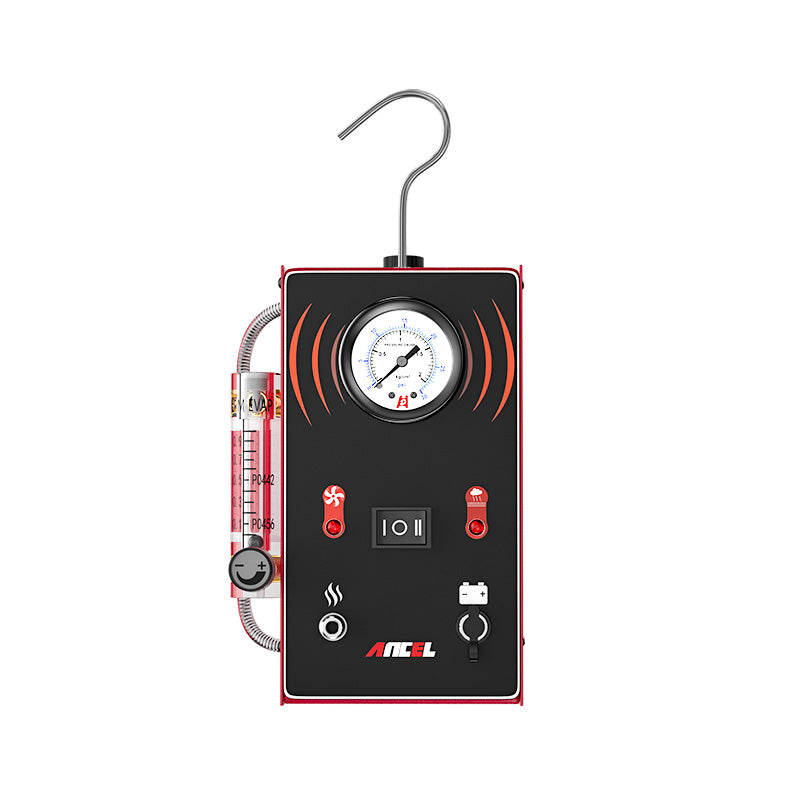
BOOST LEAK DIAGNOSIS PICK
ANCEL S300 Smoke Leak Detector
A smoke machine is useful when a Volvo has a hissing sound, underboost code or suspected intake/charge-air leak that is not obvious during a visual inspection.
Volvo Loses Power but RPM Goes Up: Think Driveline, Not Just Engine
If you press the accelerator and the tachometer climbs but the car does not gain speed normally, that pattern is different from an engine that cannot make power.
Volvo documents that transmission faults or overheating can trigger driver-display warnings and, in some cases, reduced-performance/limp-home behavior. Do not add fluid based on a generic internet procedure. Many Volvo transmissions require a model-specific level-check procedure, temperature range and fluid specification.
TRANSMISSION NOTEThe old advice to “warm it up and pull the transmission dipstick” does not apply to every Volvo. Confirm the exact gearbox and service procedure before checking or adding fluid.
Diesel Volvo Loses Power: DPF Regeneration vs. a Real Fault
Diesel owners need one extra branch in the diagnosis. Volvo states that DPF regeneration is automatic and normally takes around 10–20 minutes once the required conditions are met. A small temporary reduction in engine power, higher fuel consumption and a hot/burning smell can occur during regeneration.
Frequent short trips—especially in cold weather—can prevent the engine from reaching the conditions needed for regeneration. Over time, soot load can rise and a warning can appear.
DPF WARNINGDo not assume every diesel power-loss problem needs a forced regeneration or chemical cleaner. If the filter is fully loaded, the warning persists, the engine will not run normally, or other aftertreatment codes are present, diagnose the system before trying to “drive it clean.”
Recharge / Twin Engine Volvo: Reduced Performance Can Be Different
On plug-in hybrid Volvos, a loss of acceleration is not always an intake, turbo or fuel problem. Volvo support documentation lists hybrid messages where maximum vehicle performance can be limited when the high-voltage battery charge is too low. Other propulsion-system messages indicate a hybrid-system fault that should be checked by a workshop.
That is why the exact message matters. If your Recharge model says Reduced performance, Propulsion system or Hybrid system failure, save the message and codes before assuming the combustion engine is the only cause.
When a Volvo-Capable Scanner Is Worth Buying
A cheap generic OBD-II reader can still be useful for standard emissions codes, but power-loss problems can involve the transmission, hybrid system, throttle control, boost control or other modules.
If you work on your own Volvo regularly, a Volvo-focused or capable all-system scanner may provide more useful module coverage and live data than a basic code reader.

BEST FIT FOR VOLVO OWNERS
iCarsoft VOL V3.0 for Volvo/Saab
iCarsoft lists the VOL V3.0 as a Volvo/Saab multi-system diagnostic tool with full-system scanning on supported vehicles, live-data capability and service functions that include electronic-throttle functions and DPF-related functions.
DIY vs. Professional Diagnosis: When to Stop
Visual hose checks, an air-filter inspection and reading fault codes are reasonable starting points. Some symptoms, however, justify professional diagnosis before you keep testing on the road.
GET PROFESSIONAL HELP IF
- The car repeatedly enters reduced-performance or limp-home mode.
- The check-engine light flashes or the engine misfires heavily under load.
- You smell raw fuel, burning oil or electrical burning.
- There is heavy black, blue or white exhaust smoke.
- A transmission or hybrid-system warning appears.
- The turbo makes abnormal mechanical noise, not just a simple air hiss.
- Fuel-pressure or high-voltage hybrid diagnosis is required.
- You have already replaced parts based on codes but the same fault keeps returning.
Checklist: What to Do If Your Volvo Loses Power
| Step | Task | Checked? |
|---|---|---|
| 1 | Save the exact dashboard message and scan all available fault codes | ☐ |
| 2 | Note whether RPM rises normally or the engine itself struggles to rev | ☐ |
| 3 | Inspect intake, turbo/charge hoses, intercooler joints and clamps | ☐ |
| 4 | Check air filter and review MAF/MAP/throttle live data if available | ☐ |
| 5 | Check misfire data and ignition/fuel clues under load | ☐ |
| 6 | For diesel: check DPF warning, soot/regeneration status and EGR/aftertreatment codes | ☐ |
| 7 | For Recharge/Twin Engine: record hybrid/propulsion-system messages | ☐ |
| 8 | Book professional diagnosis if severe symptoms, safety warnings or repeated limp mode remain | ☐ |
Maintenance Habits That Help Prevent Power-Loss Problems
- Follow the maintenance schedule for your exact engine and model year rather than a generic mileage interval.
- Use the correct fuel and oil specification for your Volvo.
- Inspect turbo/charge-air hoses and clamps when servicing an older turbocharged car.
- Address misfires quickly instead of continuing to accelerate hard with a flashing warning light.
- If you own a diesel and mostly drive short urban trips, understand the DPF regeneration requirements in your owner’s manual.
- Keep the 12V electrical system healthy when multiple modules begin showing unrelated faults.
- Keep Volvo software/service campaigns current where applicable.
Related Volvo Troubleshooting Guides
Video: Volvo Losing Power Under Acceleration
The original article included this video as an additional visual reference:
💡 Evans Torres Tip: On every Volvo I have owned, I always keep a full digital service record from day one. When something goes wrong — and eventually something always does — having that history makes diagnosis faster and often saves money at the mechanic. Start your records today, even if the car is not new.
Frequently Asked Questions
Common categories include boost/intake leaks, ignition misfires, low fuel pressure, throttle/airflow faults, diesel DPF/EGR problems, transmission faults and protective reduced-performance mode. Start by saving the dashboard message and scanning for codes before replacing parts.
Volvo documents this message in connection with a temporary driveline fault where the car may enter a limp-home mode with reduced engine power to help prevent driveline damage. The underlying fault should be diagnosed rather than treated as a normal driving mode.
Yes. A split charge hose, loose clamp or intercooler connection can allow pressurized air to escape. Typical clues include hissing under load, weak acceleration and an underboost-related fault code.
If RPM rises significantly without a matching increase in road speed, investigate transmission or clutch slip and driveline faults rather than assuming the engine is not producing power.
A diesel aftertreatment problem can contribute to warnings and reduced performance. Volvo notes that normal DPF regeneration can cause a small temporary reduction in power, while repeated short trips can prevent proper regeneration and eventually trigger a warning.
A severely restricted filter can reduce airflow, so it is worth inspecting. But if the filter looks normal, do not keep replacing intake parts without checking codes, boost and live airflow data.
Low voltage can create module communication problems and multiple electronic warnings, but it should not automatically be blamed for every acceleration problem. Check 12V condition especially when several unrelated electrical faults appear at the same time.
Only follow the vehicle’s displayed instructions and use conservative judgment. Limp mode is designed to limit performance when a fault exists. If the car misfires heavily, overheats, smokes, smells of fuel/burning, or displays a stop-safely instruction, stop driving and seek assistance.
Sources & Verification
Primary Sources Used for the Updated Troubleshooting Guidance
- Volvo Support — XC60 gearbox and Reduced performance / Acceleration performance reduced
- Volvo Support — Diesel particulate filter and regeneration
- Volvo Support — Hybrid reduced performance and propulsion-system messages
- iCarsoft — VOL V3.0 for Volvo/Saab specifications
- Autel — MaxiCOM MK808S specifications
- ANCEL — S300 smoke leak detector specifications
Final Thoughts
When a Volvo loses power while accelerating, the symptom is most useful when you combine it with one more clue: the exact warning message, fault code, sound, RPM behavior or driving condition.
Start by scanning the car. Then decide whether the pattern looks like an engine that cannot make torque, a turbo/intake system losing boost, a diesel aftertreatment issue, or a driveline that cannot transfer the engine’s power to the road.
A cracked hose or loose clamp can mimic an expensive turbo problem. A transmission fault can feel like a weak engine. A normal diesel regeneration can cause a small temporary power reduction, while a persistent soot warning needs proper diagnosis. Recharge/Twin Engine models add another layer because the hybrid system can intentionally limit performance.
That diagnostic order gives you a better chance of fixing the actual cause instead of spending money on filters, sensors or a turbo that may not be faulty.
My Top Picks at a Glance
These three tools match the three most useful DIY diagnostic paths in this article: Volvo-specific fault scanning, deeper all-system/live-data diagnosis and locating difficult intake/boost leaks. You do not need all three—choose the tool that fits the problem you are actually diagnosing.
AFFILIATE DISCLOSUREAs an Amazon Associate, The Volvo Life may earn from qualifying purchases. Product availability, pricing and specifications can change. Always confirm compatibility and current listing details before ordering.
View on Amazon
TOP RELATED PICK
iCarsoft VOL V3.0
Best overall fit for a Volvo owner who wants supported full-system scanning and Volvo-focused service functions without jumping straight to a higher-priced workshop tablet.

View on Amazon
PREMIUM OPTION
Autel MaxiCOM MK808S
A more advanced all-system option with live data and active-test capability for serious DIY users and multi-car households. Confirm Volvo coverage for the exact model/year.
View on Amazon
BOOST LEAK PICK
ANCEL S300 Smoke Leak Detector
Most useful when the Volvo has a hissing sound, underboost symptoms or a suspected intake/vacuum leak that is difficult to find visually.
BUYER CHECKA scanner or smoke machine is a diagnostic aid, not a guaranteed fix. Confirm tool compatibility, read the instructions, and use the test results to identify the fault before replacing expensive components.
