


Volvo’s five-cylinder engines earned a loyal following because they combine a distinctive sound, strong midrange torque and—when maintained correctly—very good long-term durability. But “Volvo 5-cylinder” does not describe one single engine. Petrol 2.4/2.5-liter five-cylinders, turbocharged T5 variants, 2.0/2.4-liter D3/D5 diesels and different model generations have different strengths and failure points.
If you are researching Volvo 5 cylinder engine reliability, the most important thing is to identify the exact engine and model year before judging it by the badge on the trunk. Volvo reused names such as T5, D3 and D5 across different engine families, and later T5/D5-badged cars were not necessarily five-cylinder engines.
This updated guide removes the unsupported mileage promises, one-size-fits-all maintenance intervals and generic “buy/avoid” claims from the older article. Instead, it explains which Volvo five-cylinders you are actually looking at, the common petrol and diesel issues, timing-belt risk, PCV and turbo problems, high-mileage buying checks and the difference between an old five-cylinder T5 and a later four-cylinder Drive-E T5.
Are Volvo 5-cylinder engines reliable? Generally, yes—many petrol and diesel five-cylinder Volvos have proven durable when cooling-system, oil, PCV, timing-belt and turbo/emissions maintenance is kept up. However, there is no official “200,000–300,000-mile guaranteed lifespan.” A documented service history, correct timing-belt status, healthy crankcase ventilation, no overheating history and a clean diagnostic scan matter more than the odometer alone.
- Volvo introduced its transverse five-cylinder passenger-car era with the 850 in 1991.
- Petrol and diesel five-cylinders are different families: do not apply D5 diesel problems to a 2.5T petrol engine, or vice versa.
- T5 does not always mean five-cylinder: Volvo launched four-cylinder Drive-E T5 engines during the mid-2010s transition.
- D3 and D5 badges also changed over time: some D3/D5 engines were five-cylinder, while later Drive-E diesels were four-cylinder.
- Timing-belt service is critical: use the exact model/year Service & Warranty schedule rather than one universal mileage interval.
- Common petrol concerns: PCV/crankcase pressure, oil leaks, ignition faults, cooling-system aging and turbo/boost problems on forced-induction versions.
- Common diesel concerns: EGR/DPF-related faults on equipped engines, injectors/fuel-system issues, turbo/boost leaks and age-related cooling or oil leaks.
- Condition beats reputation: a neglected “legendary” five-cylinder can be a worse purchase than a well-maintained higher-mileage example.
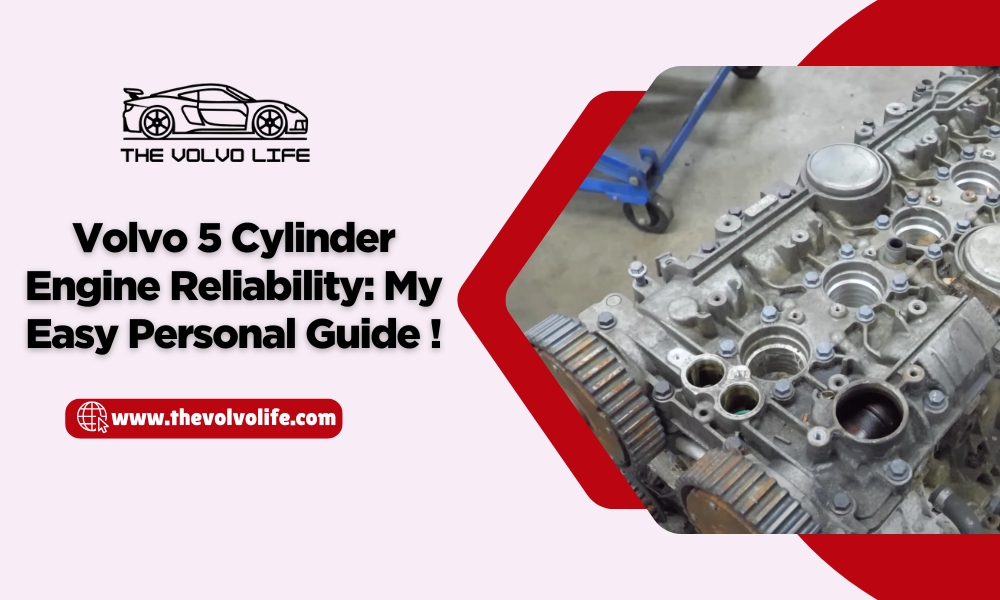
What Is the Volvo 5-Cylinder Engine?
Volvo’s modern five-cylinder passenger-car story became famous with the Volvo 850. Volvo introduced the 850 in 1991 with a transversely mounted inline-five driving the front wheels, an unusual layout at the time and a major departure from Volvo’s traditional rear-wheel-drive cars.
Over the following decades, five-cylinder engines appeared across the 850, S70, V70, S60, XC70, XC90, C30, C70, S40/V50 and other Volvo models, depending on market and model year.
But there were several major versions:
| Engine Type | Typical Examples | What to Know |
|---|---|---|
| Naturally aspirated petrol inline-5 | 2.3, 2.4 and related “whiteblock” petrol engines | Generally simpler than turbo variants; age-related PCV, seals, ignition and cooling issues matter most |
| Turbo petrol inline-5 | 2.3T, 2.4T, 2.5T, many older T5 applications | Strong performance; adds turbo, boost-hose and heat-management complexity |
| 2.4 D5 / 2.4D diesel inline-5 | V70, XC70, XC90, S60, S80 and others in diesel markets | Strong torque and long-distance ability; later emissions hardware adds EGR/DPF complexity |
| 2.0 five-cylinder D3 diesel | Some early-2010s European-market models | Derived from the established five-cylinder diesel architecture with reduced displacement |
| Later Drive-E T5/D4/D5 | Mid-2010s onward depending on market/model | Often four-cylinder—badge alone no longer identifies cylinder count |
A 2012 U.S.-market S60 T5 used a 2.5-liter turbocharged five-cylinder, and a 2016 S60 Cross Country T5 AWD still used Volvo’s 2.5-liter five-cylinder. But Volvo also launched four-cylinder Drive-E T5 engines during the same broader era. Always verify the VIN, engine code and model-year specification.
How Reliable Is a Volvo 5-Cylinder Engine?
The best overall answer is reliable when maintained, but not maintenance-proof.
These engines developed their reputation over long production runs and broad use across family cars, wagons, crossovers and performance models. The core petrol architecture can tolerate high mileage well when lubrication, cooling and crankcase ventilation remain healthy. Volvo’s D5 diesels also developed a strong long-distance reputation, especially in cars driven regularly at operating temperature.
However, age now matters as much as the original engine design. Many five-cylinder Volvos are 10, 15, 20 or even 30 years old. Rubber hoses, seals, vacuum lines, cooling components, electrical connectors, engine mounts, turbo plumbing and emissions hardware can all age even when the basic engine remains mechanically strong.
Diesel models
Best suited to regular longer trips; later D5/D3 emissions equipment can be less happy with repeated short-trip use.
How Long Can a Volvo 5-Cylinder Engine Last?
There is no official Volvo mileage limit that says a five-cylinder engine should last 200,000, 250,000 or 300,000 miles.
High-mileage examples do exist, but publishing a fixed “expected lifespan” creates false confidence. An engine with 160,000 miles and a history of overheating, delayed timing-belt service and poor oil changes can be a much worse buy than one with 220,000 documented miles and careful maintenance.
For a used-car buyer, these matter more than an internet mileage claim:
- Documented oil-change history
- Timing-belt and tensioner history where applicable
- No serious overheating history
- Healthy PCV/crankcase ventilation
- No unexplained coolant loss
- No persistent misfire or low-compression symptoms
- Normal cold-start behavior
- No heavy blue smoke under boost
- Clean or explainable diagnostic fault history
Volvo Petrol 5-Cylinder Reliability
The petrol five-cylinder family includes naturally aspirated and turbocharged versions in several displacements and states of tune.
The naturally aspirated engines remove the turbocharger and some boost-related plumbing, but that does not automatically make every naturally aspirated version “better” or every turbo version “bad.” The condition of the actual car matters more.
Turbocharged 2.4T, 2.5T and T5-style engines add excellent midrange torque and character, but they place more importance on clean oil, healthy crankcase ventilation, intact intercooler/boost hoses and a turbocharger that is not leaking oil excessively.
Petrol 5-Cylinder Strengths
- Smooth, distinctive inline-five power delivery
- Strong torque from relatively compact displacement
- Long production history and good parts knowledge in the Volvo specialist community
- Turbo variants can deliver strong performance without a large six-cylinder engine
- Many basic service parts remain widely available
Most Common Volvo 5-Cylinder Petrol Problems
1. PCV / Crankcase Ventilation Problems
The crankcase ventilation system is one of the first systems to check on an older petrol five-cylinder.
When the system becomes restricted or fails, crankcase pressure can increase. Symptoms can include oil leaks, whistling, oil around seals, unstable idle or excessive vacuum/pressure behavior at the oil filler.
Do not diagnose the PCV system from a single “glove test” or dipstick trick alone. The exact system varies across engine generations, and a proper pressure/vacuum check plus inspection of the oil trap, hoses and diaphragm-style components where fitted is more useful.
2. Oil Leaks
Oil leaks are common on aging five-cylinder Volvos, but the source matters.
Possible leak areas include cam/crank seals, oil cooler/filter housing areas, turbo oil lines on turbo models, crankcase-ventilation-related seals and other gaskets depending on engine generation.
A leaking engine does not automatically mean internal wear. Clean the area, locate the real source and correct any crankcase-pressure problem before replacing random seals.
3. Ignition Coils and Spark Plugs
A rough idle, flashing check-engine light, hesitation or misfire under load can come from ignition coils or plugs rather than a failing engine.
Scan for misfire data and move through diagnosis logically. Do not replace all coils simply because the car is old unless testing or history supports it.
4. Turbo and Boost-System Problems
Turbo five-cylinders can develop boost leaks, split hoses, worn control components or turbocharger wear.
Warning signs include:
- Sudden loss of boost or reduced power
- Whistling/siren noises that change with boost
- Blue smoke and rising oil consumption
- Oil in boost plumbing beyond normal film levels
- Underboost or airflow-related fault codes
Before replacing the turbo, check charge pipes, intercooler connections, vacuum/control lines and stored fault data.
If your Volvo is losing power under acceleration, see Volvo Loss of Power When Accelerating.
5. Cooling-System Aging and Overheating
Overheating is one of the fastest ways to turn a durable engine into an expensive repair.
On an older Volvo, inspect coolant level, hoses, radiator condition, expansion tank, thermostat/water-pump history and signs of previous overheating. Do not dismiss recurring coolant loss as “normal for an old car.”
Volvo D5 5-Cylinder Diesel Reliability
Volvo’s five-cylinder D5 diesels are a separate discussion from the petrol “whiteblock” engines.
The D5 became well known for strong low-rpm torque and long-distance efficiency. Volvo’s later 2.4-liter D5 versions used advanced common-rail injection, and some generations added sequential twin turbochargers to broaden the torque curve.
Volvo also produced a 2.0-liter five-cylinder D3 in the early 2010s. Volvo described it as being based on the established 2.4-liter five-cylinder diesel architecture but with reduced displacement.
What Makes the D5 Attractive?
- Strong low-end torque
- Very good long-distance cruising ability
- Good fuel economy relative to output
- Long-running Volvo diesel architecture with extensive specialist knowledge
What Makes the D5 More Complex?
- Common-rail fuel system and high-pressure injectors
- Turbocharging and boost-control hardware
- EGR systems
- DPF/aftertreatment on equipped generations
- More sensitivity to repeated short trips on emissions-equipped cars
Common Volvo D5 / D3 Five-Cylinder Problems
1. EGR and Intake Contamination
Diesel exhaust-gas-recirculation systems can accumulate soot and oil contamination over time. Symptoms can include poor response, fault codes and reduced performance.
Do not assume every diesel hesitation is “just EGR.” Scan first and confirm airflow, boost and emissions-system data.
2. DPF Regeneration Problems on Equipped Cars
Later diesel cars fitted with a particulate filter need the correct operating conditions to complete regeneration. Repeated short journeys can make soot-management problems more likely.
If the car is showing DPF or emissions warnings, follow the owner-manual procedure for the exact model rather than attempting aggressive “Italian tune-up” advice from a generic forum.
3. Injector and Fuel-System Issues
Hard starting, rough running, smoke or cylinder imbalance can involve injectors or fuel delivery. Common-rail diesel diagnosis should use live data and proper leak-off/balance testing rather than parts swapping.
4. Turbo / Boost Leaks
Like the petrol turbo engines, D5 diesels can lose power from boost plumbing, intercooler leaks, control faults or actual turbo wear.
5. Timing-Belt Service
Many Volvo five-cylinder diesels also use a timing belt. The correct replacement interval varies by model, year and market, so use the exact Service & Warranty Booklet or Volvo service information.
The older article used figures such as 90,000–105,000 miles or “105,000 miles / 10 years” as if they applied to every Volvo five-cylinder. They do not. Verify the service schedule for the exact VIN/model-year engine.
The T5 Badge Is the Biggest Source of Confusion
For years, enthusiasts associated T5 with Volvo’s turbocharged five-cylinder petrol engines. That association is historically understandable—but it stopped being a reliable rule.
For example:
| Example | Engine Reality |
|---|---|
| 2012 U.S. Volvo S60 T5 | 2.5-liter turbocharged five-cylinder, 250 hp |
| 2016 U.S. S60 Cross Country T5 AWD | 2.5-liter turbocharged five-cylinder, 250 hp |
| Drive-E T5 introduced during mid-2010s transition | 2.0-liter turbocharged four-cylinder |
| 2019-era T5-badged modern Volvos | Drive-E four-cylinder family—not a five-cylinder engine |
A section titled “2019 T5 Issues” does not belong in a guide specifically about Volvo five-cylinder reliability. By that era, T5 was being used on Volvo’s 2.0-liter Drive-E four-cylinder powertrains.
D3 and D5 Badges Can Be Confusing Too
The same caution applies to diesel badges.
Volvo offered five-cylinder D5 engines and, for part of the early 2010s, a five-cylinder 2.0-liter D3. But later Drive-E D4/D5 diesels were four-cylinder engines.
So if a used-car listing says “D5,” verify the engine code before assuming it has the classic five-cylinder diesel.
Which Volvo Models Used Five-Cylinder Engines?
Availability differed by market and year, but important examples include:
| Model | Five-Cylinder Examples | Buyer Note |
|---|---|---|
| Volvo 850 | Petrol inline-five, turbo variants and some five-cylinder diesel applications | The model that introduced Volvo’s transverse five-cylinder passenger-car architecture |
| S70 / V70 | 2.4/2.5 petrol and turbo five-cylinders; diesel depending on market | Condition and PCV/timing history are important today |
| S60 | Multiple petrol five-cylinders; D5/D3 in some markets | Do not assume every later T5 is five-cylinder |
| XC70 | 2.5T petrol and D5 diesel examples | Check AWD/transmission condition as well as engine condition |
| XC90 | Early T5 petrol; multiple D5 diesel versions outside some markets | Vehicle weight makes overall drivetrain condition important |
| C30 / C70 / S40 / V50 | 2.4/T5 petrol and D5 variants depending on market | Compact platform with strong five-cylinder character |
| XC60 / V60 / later S60 | D3/D5 diesels and some five-cylinder petrol applications depending on year/market | Drive-E transition makes engine-code verification essential |
Which Volvo 5-Cylinder Is Best?
There is no single engine code that deserves a universal “best” label.
For U.S. petrol buyers, the 2.4/2.5-liter turbo five-cylinders used in well-maintained S60, V70, XC70, C70 and related models are popular because they combine strong torque with a huge knowledge base among Volvo specialists.
For diesel markets, a well-documented 2.4 D5 can be an excellent long-distance engine, but the emissions and fuel-system hardware means buying the correct condition is more important than buying the strongest badge.
Most importantly, the older article’s “B5254FS = avoid” and “high-pressure turbo = caution” table was too simplistic. A naturally aspirated five-cylinder is not automatically a bad engine, and a high-output turbo engine is not automatically unreliable.
When choosing between two cars, prioritize timing-belt documentation, oil-change records, cold-start behavior, cooling-system health, PCV condition and diagnostic results over the exact T5/D5 badge.
7-Step Pre-Purchase Check for a Used Volvo 5-Cylinder
Start the Engine Completely Cold
A seller-prewarmed engine can hide hard starting, smoke, noisy lifters/tensioners, misfires or diesel glow/fuel issues.
Verify the Exact Engine
Use VIN/model-year data and the engine code. Do not rely only on “T5,” “D3” or “D5” badges.
Confirm Timing-Belt History
If the engine uses a timing belt and documentation is missing, price the correct service into your purchase decision.
Check PCV, Oil Leaks and Coolant Loss
Look for fresh oil, pressure-related leaks, coolant residue, low fluid levels and signs of previous overheating.
Drive Under Light and Heavy Load
Watch for misfires, boost hesitation, smoke, transmission flare, vibration or reduced-power messages.
Scan More Than the Engine ECU
A Volvo-capable full-system scan can reveal faults in powertrain, ABS, airbag, body and communication modules that a basic generic reader may miss.
Inspect the Whole Car, Not Just the Engine
AWD, transmission, suspension, HVAC and electronics can cost more than an engine repair on an old Volvo. A strong five-cylinder does not make the rest of the car automatically healthy.
Contextual Diagnostic Tool: iCarsoft VOL V3.0
For a used Volvo, a Volvo-focused scanner is more useful than repeatedly buying parts from generic P-codes. iCarsoft lists the VOL V3.0 as a Volvo/Saab multi-system diagnostic tool with supported-system scanning, fault-code and live-data functions.

iCarsoft VOL V3.0 for Volvo/Saab
Useful for a pre-purchase or ownership scan when you need more Volvo-specific system access than a basic engine-code reader. Confirm exact year/model coverage before buying.
Volvo 5-Cylinder Maintenance: What Actually Matters
A single maintenance schedule cannot cover three decades of Volvo five-cylinder engines.
The older article used universal rules such as “oil every 5,000–7,500 miles,” “spark plugs at 60,000,” and “timing belt every 90,000–105,000 miles.” Those numbers may match some owner habits or some specific schedules, but they should not be published as rules for every Volvo five-cylinder.
Volvo’s own guidance is to follow the Service & Warranty information for the exact car.
| Maintenance Area | Better 2026 Guidance |
|---|---|
| Engine oil | Use the exact Volvo-approved specification and interval for the engine/model/year |
| Timing belt | Verify exact interval by VIN/model-year; replace related wear items according to service procedure |
| PCV system | Inspect when crankcase-pressure, oil-leak or idle symptoms appear; service as required |
| Cooling system | Repair leaks promptly and avoid overheating; use the specified coolant/service procedure |
| Spark plugs | Use the correct plug and interval for the exact petrol engine |
| Diesel EGR/DPF | Follow warning-specific owner/service procedures; short-trip use can matter on equipped engines |
| Turbo / boost system | Inspect hoses, control lines and oil/boost symptoms before condemning the turbocharger |
What Oil Should You Use in a Volvo 5-Cylinder?
Do not choose engine oil only from the fact that the engine has five cylinders.
Volvo changed viscosity and performance specifications across petrol/diesel engines, markets and model years. The correct oil for an early 850, a 2007 S60 2.5T and a later D5 is not automatically the same.
Use the owner manual/service information for the engine code. For model-specific guides, see:
Can You DIY a Volvo 5-Cylinder?
Many routine jobs are approachable for an experienced DIY owner, but the engine family spans simple 1990s cars through later networked vehicles with turbocharging, diesel common-rail fuel systems and emissions hardware.
Good DIY jobs can include:
- Basic oil/filter service when the correct spec and procedure are known
- Spark plugs on applicable petrol engines
- Air filters
- Visual coolant/oil-leak inspection
- Basic boost-hose inspection
- Diagnostic scanning and live-data review
Jobs such as timing-belt replacement, diesel high-pressure fuel work, internal turbo repair, cylinder-head work and complex emissions diagnostics should match your actual skill level and tools.
Volvo 5-Cylinder vs Volvo Drive-E 4-Cylinder
Volvo launched its new 2.0-liter four-cylinder Drive-E engine family in the 2010s as part of a broader modular powertrain strategy.
The change does not mean Volvo abandoned the inline-five because it was inherently unreliable. The newer engine strategy focused on lower displacement, modularity, efficiency and emissions while using turbocharging—and in some versions supercharging—to deliver strong output from four cylinders.
The two generations feel different:
| Characteristic | Classic Volvo Inline-5 | Drive-E Inline-4 |
|---|---|---|
| Character | Distinctive five-cylinder exhaust/engine note | More conventional four-cylinder sound |
| Architecture | Multiple 2.0–2.5L petrol/diesel five-cylinder families | Modular 2.0L four-cylinder family |
| Age today | Mostly older/high-mileage vehicles | Newer generation with different electronics/emissions systems |
| Buying focus | History, timing system, PCV, leaks, cooling, turbo/diesel systems | Different generation-specific issues; do not use a five-cylinder problem list |
Is a High-Mileage Volvo 5-Cylinder Worth Buying?
It can be, but only if the whole car makes financial sense.
A five-cylinder engine may still be healthy at high mileage while the automatic transmission, AWD system, suspension, climate control, interior electronics or body condition need significant work.
Good Signs
- Cold-starts cleanly without major smoke or knocking
- Stable idle and smooth power delivery
- Timing-belt documentation where required
- Consistent oil-change/service history
- No repeated overheating or coolant-loss history
- PCV system behaving normally
- No major underboost/misfire/emissions warnings
- Transmission and AWD operate correctly
- The seller cannot explain major warning lights.
- Timing-belt history is unknown and the engine is overdue by the exact service schedule.
- The car is actively overheating or losing coolant.
- There is heavy persistent blue/white smoke with no diagnosis.
- The crankcase has obvious abnormal pressure and multiple oil leaks.
- The seller cleared codes immediately before your inspection.
Why Did Volvo Stop Using Five-Cylinder Engines?
Volvo’s move away from five-cylinders was part of a broader powertrain strategy rather than a verdict that the engines were unreliable.
The Drive-E family was built around compact, modular four-cylinder engines designed to deliver performance with lower fuel consumption and emissions. The phase-out happened gradually across markets, so there is no single model year when every five-cylinder Volvo disappeared worldwide.
That gradual transition is why a 2016 T5 in one market can still be a five-cylinder while another T5 from a similar era is already a four-cylinder.
Related Volvo Reliability and Engine Guides
💡 Evans Torres Tip: On every Volvo I have owned, I always keep a full digital service record from day one. When something goes wrong — and eventually something always does — having that history makes diagnosis faster and often saves money at the mechanic. Start your records today, even if the car is not new.
Frequently Asked Questions
Generally, yes. The petrol and D5 diesel five-cylinder families can be very durable when timing-system, oil, cooling, PCV, turbo and emissions maintenance is handled correctly. Condition and service history matter more than reputation alone.
Volvo does not publish a guaranteed mileage lifespan. High-mileage examples above 200,000 miles exist, but maintenance history, overheating, timing-belt service, oil use and overall vehicle condition determine whether a specific engine is a good long-term bet.
Common areas to inspect include crankcase ventilation/PCV, age-related oil leaks, ignition coils and plugs, cooling-system leaks and turbo/boost problems on turbocharged versions.
The five-cylinder D5 has a strong long-distance reputation, but later versions add common-rail fuel, turbo, EGR and DPF complexity. A well-documented car that has not spent its life on short trips is generally more attractive than one with unknown emissions-system history.
No. Older T5 applications often used turbocharged five-cylinder petrol engines, but Volvo later used the T5 badge on 2.0-liter Drive-E four-cylinder engines. Verify the engine code/model year instead of relying on the badge.
No. Many classic D5 engines were 2.4-liter five-cylinders, but later Drive-E diesel powertrains also used D5 branding with four-cylinder engines in some markets.
There is no universal winner. Well-maintained 2.4/2.5-liter petrol five-cylinders and 2.4 D5 diesels are both respected. For a used car, complete service history and condition are more important than choosing a single “best” engine code.
There is no single interval for every Volvo five-cylinder. Use the exact Service & Warranty Booklet or Volvo service information for your model year, engine and market.
Volvo transitioned toward its modular 2.0-liter Drive-E four-cylinder engine family to improve powertrain modularity, efficiency and emissions performance. The five-cylinder phase-out happened gradually across models and markets.
No in the modern Drive-E applications relevant to that era. The T5 badge had already been reused for Volvo’s 2.0-liter turbocharged four-cylinder engine family, so a “2019 T5 problems” section should not be treated as part of classic five-cylinder reliability.
Sources & Verification
Primary Sources Used for This Updated Reliability Guide
- Volvo Cars Heritage — Volvo 850 and the Transverse Five-Cylinder
- Volvo Car USA — 2012 S60 T5 2.5-Liter Five-Cylinder Specifications
- Volvo Car USA — 2016 S60 Cross Country T5 Five-Cylinder Specifications
- Volvo Cars — Drive-E Four-Cylinder Engine Family Introduction
- Volvo Cars — XC60 D5 and Five-Cylinder 2.0 D3
- Volvo Cars — 2015 S80 Four-Cylinder T5 and Five-Cylinder D5 Comparison
- Volvo Support — Follow the Model-Specific Volvo Service Programme
- iCarsoft — VOL V3.0 Volvo/Saab Diagnostic Coverage
- Autel — MaxiCOM MK808S Diagnostic Functions
- TOPDON — BT200 Battery/Cranking/Charging Tester
Final Verdict: Is the Volvo 5-Cylinder a Reliable Engine?
Yes, a well-maintained Volvo five-cylinder can be an excellent long-term engine—but the reputation should never replace an inspection.
The petrol five-cylinders are appealing because of their smooth torque, distinctive sound and durable basic architecture. The D5 diesels add excellent long-distance torque and economy but require more attention to fuel and emissions systems on later versions.
The most expensive mistakes are buying by badge alone, assuming every T5/D5 is a five-cylinder, trusting one universal timing-belt interval, or paying a premium for a “legendary engine” with no service history.
Verify the exact engine, start it cold, inspect the PCV/oil/cooling systems, confirm timing-belt history where applicable, scan the vehicle and evaluate the whole car. If those checks are good, a Volvo five-cylinder remains one of the most characterful used Volvo powertrains to own.
My Top Picks at a Glance
These three tools fit the real ownership needs of an aging five-cylinder Volvo: Volvo-specific diagnostics, broader professional-level system testing and checking the 12V/charging system before blaming electronic engine symptoms on the powertrain itself.
TOP VOLVO-SPECIFIC PICK
iCarsoft VOL V3.0
A Volvo/Saab-focused multi-system scanner for supported fault codes, system scans and live data. A strong match for owners who maintain older Volvos and want more than a generic engine-code reader.

PREMIUM DIAGNOSTIC PICK
Autel MaxiCOM MK808S
A higher-end multi-brand diagnostic tablet with all-system code functions, live data, active tests and service functions. Better suited to serious DIY users or households maintaining several vehicles.

12V HEALTH CHECK PICK
TOPDON BT200 Battery Tester
Useful for battery, cranking and charging-system checks when an older Volvo has slow starting, multiple low-voltage faults or electrical symptoms that can complicate engine diagnosis.
