


If your Volvo XC60 shows “Engine System Service Required,” treat it as a fault message that needs diagnosis—not as a normal maintenance reminder and not as proof that the engine itself is failing.
Volvo’s own message tables distinguish Service required from regular maintenance messages such as Book time for maintenance, Time for maintenance, and Maintenance overdue. On supported XC60s, “Service required” means the vehicle should be checked as soon as possible.
The exact phrase is most familiar on older XC60 generations. Newer XC60s may use different notification wording, symbols and vehicle-status messages, but the same rule applies: read the full message, note the warning symbol, scan the relevant control systems and diagnose the stored fault before clearing anything.
Do not reset this warning first. Record the message, check whether any red/amber warning symbol is present, scan the XC60 for DTCs, inspect 12V power if several electrical faults appear together, and then test the system identified by the codes. If the display says Stop safely, Turn off engine, or Service urgent, follow that higher-priority instruction. If it only says Service required and the car drives normally, arrange diagnosis as soon as possible rather than ignoring it.
- “Service required” is not the scheduled-maintenance reminder. Volvo lists regular-maintenance messages separately.
- The message alone does not identify the failed part. Engine, emissions, fuel/air, boost, ignition, sensor, voltage or communication faults can trigger a system-specific service message.
- Check Engine and Engine System Service Required are different alerts, but they can appear together.
- Do not clear codes before saving them. Freeze-frame and fault status help diagnose intermittent problems.
- Do not disconnect the battery just to reset the message. Battery disconnection can erase useful diagnostic information and reset OBD readiness.
- Do not use the trip-odometer maintenance-reset procedure for an engine-system fault.
- “020” by itself is not a complete generic OBD-II powertrain DTC. Standard OBD DTCs use a format such as P####.
- Current XC60 software can be updated OTA or in a workshop depending on release and vehicle. Software should be checked only after the actual fault path is understood.

What Does “Engine System Service Required” Mean on a Volvo XC60?
On older XC60 support documentation, Volvo groups driver messages by urgency. Service required means the vehicle should be checked by a workshop as soon as possible. That is different from Service urgent, which calls for immediate inspection, and from Stop safely or Stop engine, which indicate a serious risk of damage.
It is also different from the scheduled-service reminder. Volvo separately lists:
- Book time for maintenance
- Time for regular maintenance
- Maintenance overdue
Do not treat “Engine System Service Required” as simply “your oil change is due.” A normal maintenance reminder and an engine-system fault message are not the same thing.
Is It the Same as the Check Engine Light?
No—but they can be related.
The Check Engine / emissions-control symbol is part of OBD-II emissions monitoring. Volvo states that when an emissions-control fault is detected, the Check Engine light may illuminate and a fault is stored in the OBD system.
“Engine System Service Required” is a Volvo driver-information message. Depending on the fault, the message can appear with an emissions warning, an information symbol or another system-specific indicator.
| Alert | What It Tells You | What to Do |
|---|---|---|
| Engine System Service Required | A system fault requires diagnosis/service | Read full message + scan the car as soon as practical |
| Check Engine / Emissions symbol | OBD/emissions-control fault detected | Read stored DTCs and diagnose emissions/powertrain fault |
| Service urgent | Higher-priority fault | Have vehicle checked immediately |
| Stop safely / Turn off engine | Serious risk of damage or safety concern | Stop as instructed and seek assistance |
| Regular maintenance message | Scheduled service is due/approaching | Book the scheduled maintenance |
Can You Keep Driving?
The message text by itself is not enough to give a universal yes/no answer. Use the accompanying symbol, how the engine behaves and any additional message.
- The display says Stop safely or Turn off engine.
- A red warning symbol appears.
- Oil-pressure warning appears.
- Engine-temperature warning appears.
- The engine is severely misfiring, knocking or losing power.
- You smell fuel, see smoke or smell burning insulation/oil.
- The car repeatedly stalls or cannot maintain normal road speed safely.
If the only instruction is Service required, the XC60 drives normally and there are no red/high-priority warnings, avoid unnecessary hard driving and arrange diagnosis as soon as possible.
Common Causes: Use the Fault Code, Not a Guessing List
The old version of this article treated a loose gas cap, battery voltage, sensors, software, emissions, throttle body and injectors almost like equally likely causes. In reality, the message is too broad to rank the cause without DTCs and symptoms.
A better approach is to group the possibilities by system:
| Fault Family | Typical Clues | Useful Tests |
|---|---|---|
| 12V power / low voltage | Slow start, multiple unrelated warnings, communication codes | Battery state/health, charging performance, connection voltage drop |
| Air metering / MAF / MAP / intake leak | Lean codes, hesitation, poor idle, underboost | Live data, smoke/leak test, sensor inspection |
| Ignition / misfire | Rough running, flashing MIL, cylinder-misfire DTCs | Misfire counters, coils/plugs, injector/compression comparison |
| Fuel pressure / injector | Hard start, lean/rich condition, misfire, rail-pressure faults | Requested vs actual pressure, injector data, pressure test where applicable |
| Boost / turbo control | Reduced power, underboost/overboost codes | Boost data, charge-air leak test, actuator/control diagnosis |
| Emissions / catalyst / oxygen sensor | Check Engine light, catalyst/mixture/O2 DTCs | Freeze-frame, O2/AFR data, leak and fuel-control diagnosis |
| Throttle / pedal control | Poor throttle response, limp/reduced power, throttle DTCs | Commanded/actual throttle data, adaptation where specified |
| Software / module communication | Network codes, intermittent system behavior, update-related service information | Full-system scan, power/ground first, current Volvo software status |
1. Scan the XC60 Before Clearing Anything
This is the highest-value first step after recording the message.
Save:
- Diagnostic trouble codes
- Whether each code is current/active, pending or stored
- Freeze-frame data
- Engine temperature
- Battery/control-module voltage
- Fuel trims
- Misfire information
- Boost/airflow data when relevant
A generic OBD2 reader can be useful for emissions/powertrain codes. A more capable all-system scanner can provide broader information from engine, transmission, ABS, SRS and other modules depending on XC60 model year and tool coverage.

Innova 5610 CarScan Pro
Innova’s premium handheld scanner offers all-system diagnostics, OEM/OBD2 live data, bidirectional controls and advanced resets on supported vehicles. It is a stronger first-pass tool than a basic code reader when an XC60 warning may involve more than one system.
2. Check the 12V Battery When Multiple Faults Appear Together
Low or unstable 12V power can produce strange communication and module symptoms, but do not assume voltage is the cause merely because the warning appeared after battery work.
Check:
- Battery state of charge
- Battery state of health
- Voltage during starting
- Charging-system behavior
- Positive/negative terminal condition
- Ground voltage drop
Do not automatically replace the battery at a fixed age such as “4–5 years.” Battery life varies with climate, usage, charging and battery type; test the actual battery.

Schumacher SC1280
A fully automatic 6V/12V charger and maintainer for standard, AGM, gel and deep-cycle lead-acid batteries. Schumacher lists 15A rapid charging, 3A maintenance and automatic voltage detection.
For a dedicated XC60 starting/charging guide, see Volvo 12V Battery Critical Charging Fault and Volvo XC60 Won’t Start.
3. Air-Metering, MAF and Intake Faults
Lean/rich codes, unstable idle, hesitation and reduced performance can point toward air metering or an intake leak. Do not replace a mass-airflow sensor from one code alone.
A reasonable order is:
- Check air-filter installation and intake ducting.
- Inspect for loose clamps, split hoses or disconnected vacuum/PCV lines.
- Compare MAF/MAP values with operating conditions.
- Check fuel trims and freeze-frame data.
- Clean the MAF only if contamination is plausible and the exact sensor is suitable for the cleaning procedure.

CRC 05110 Mass Air Flow Sensor Cleaner
A fast-evaporating, plastic-safe cleaner specifically intended for mass-airflow sensors. It is appropriate only when diagnosis suggests a contaminated MAF—not as a generic “clear the warning” spray.
4. Misfire, Spark Plug and Ignition-Coil Faults
If the XC60 runs rough or the Check Engine light flashes, treat misfire diagnosis as a priority.
Use cylinder-specific misfire data where available. Then compare:
- Spark-plug condition and correct specification
- Ignition-coil operation on gasoline engines
- Injector operation
- Compression when one cylinder remains consistently weak
- Fuel mixture and intake leaks when multiple cylinders are affected
Do not continue normal driving with a severe active misfire. Unburned fuel can overheat the catalytic converter and the underlying fault can worsen.
5. Fuel Pressure and Injector Problems
Hard starting, lean/rich faults, stalling, misfire and poor acceleration can come from fuel-pressure or injector problems—but “bad fuel” is not a diagnosis.
Use scan data first. On systems where a mechanical fuel-pressure test is appropriate, compare measured pressure with the correct engine specification and operating condition.
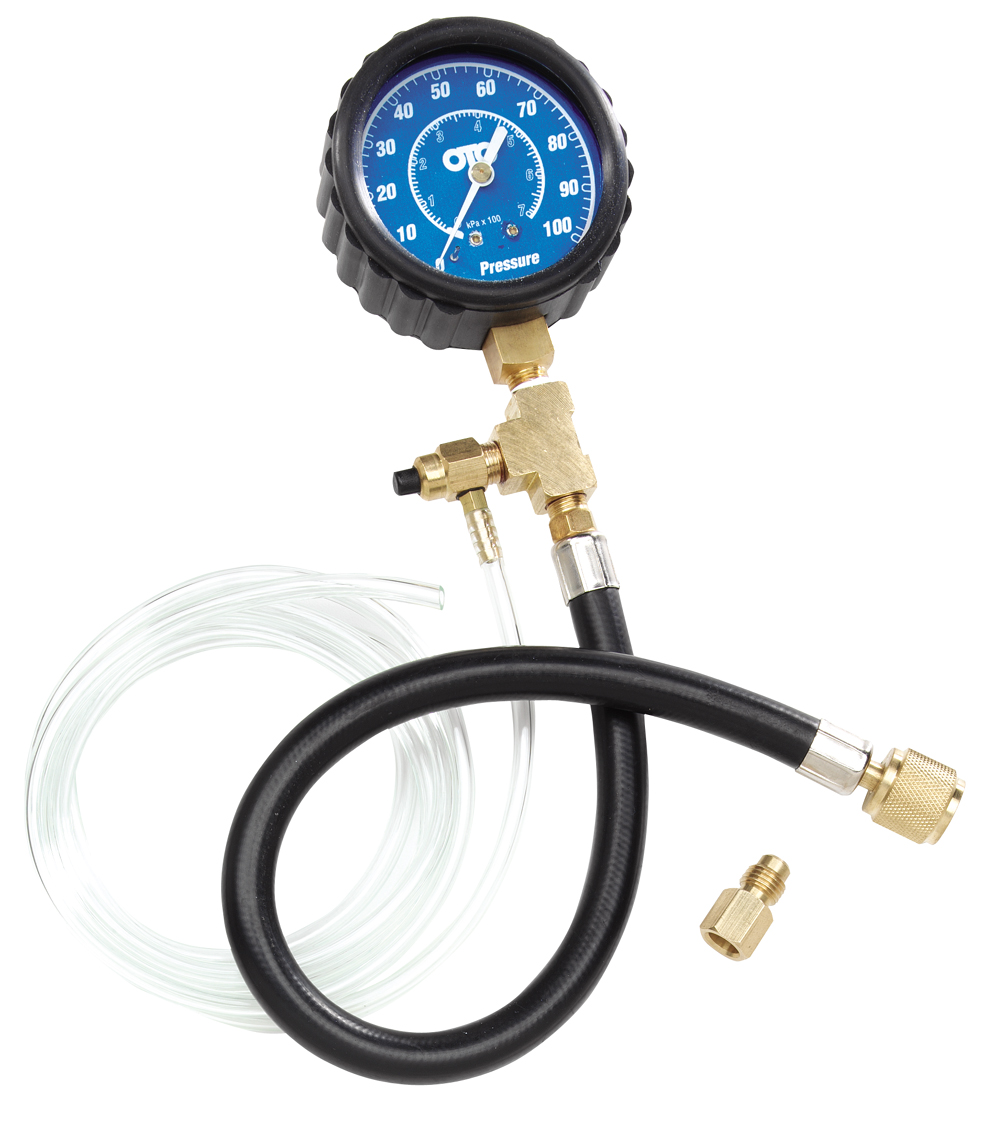
OTC 5630 Fuel Pressure Tester Kit
OTC’s professional-style kit uses a 0–100 PSI / 0–700 kPa gauge, solid-brass fittings and a pressure-relief valve. It can help isolate fuel-pump, regulator, filter and line faults on compatible fuel systems.
6. Turbo, Boost and Reduced-Performance Faults
If the warning appears with reduced acceleration or a reduced-performance message, investigate requested vs actual boost rather than replacing the turbocharger from the warning text.
Common diagnostic branches include:
- Charge-air hose or intercooler leak
- Boost-control actuator/solenoid issue
- Wastegate or turbo-control problem
- MAF/MAP sensor data
- Fuel/ignition fault limiting torque
- Actual turbocharger wear or damage
Related guide: Volvo Loss of Power When Accelerating.
7. Emissions, O2 Sensor and Catalyst Codes
A catalyst-efficiency code such as P0420 does not automatically mean “replace the catalytic converter.” Exhaust leaks, mixture problems, misfires, oil consumption and oxygen-sensor behavior can all affect catalyst-monitor results.
Use freeze-frame data and upstream/downstream sensor behavior, and repair active mixture/misfire faults before condemning an expensive catalyst.
8. Throttle-Body and Accelerator-Control Faults
A dirty throttle bore can contribute to airflow/idle problems on some engines, but electronic-throttle faults can also involve the throttle actuator, pedal sensor, wiring, adaptation or control module.
If a throttle-related code is stored, diagnose commanded vs actual throttle position and perform the specified adaptation/relearn only when the service procedure calls for it.
9. Software and Calibration: Check It, Don’t Blame It Automatically
The old article repeatedly treated software as a likely explanation for multiple model years without evidence.
Current Volvo XC60 software really is updated regularly. Volvo’s 2026 support pages show OTA and workshop-only software releases, including stability refinements and drive-system/power-supply adjustments.
But software should be a verified diagnostic branch, not an excuse to ignore a stored hardware fault.
Scan and document the fault → verify power/ground and relevant hardware → check current software/technical information → update only when Volvo’s service path or diagnosis supports it → verify the fault does not return.
10. Why “Fault Code 020” Alone Is Not Enough
The old article treated “020” as though it were a standard fuel-injector code.
Generic OBD-II DTCs are alphanumeric codes in a format such as P####. Examples include P0201, P0300 or P0420. A scanner that displays only “020” may be truncating a code, showing a manufacturer/module-specific identifier or using a different fault format.
Record the complete code exactly as the scan tool displays it, including P/B/C/U prefix, all digits, reporting module and fault status. Volvo-specific faults may require a Volvo-capable scanner or VIDA for correct interpretation.
11. A 7-Step Diagnostic Workflow

Photograph the Message and Symbols
Record the full wording before restarting or clearing anything. Red/amber symbols change the urgency.
Scan Before Resetting
Save all current, pending and stored DTCs plus freeze-frame data.
Check 12V Power if Faults Are Widespread
Multiple unrelated communication/module faults justify battery, charging and connection testing.
Follow the Code Family
Misfire → ignition/fuel/compression. Lean → air leak/MAF/fuel. Boost → charge-air/control. Emissions → mixture/leak/sensor/catalyst diagnosis.
Use Live Data and Physical Tests
Compare requested/actual values and test the circuit or mechanical system before replacing the component named in a code description.
Check Software / Service Information
If hardware and power checks support it, verify whether a Volvo software update or technical service procedure applies.
Clear Only After Repair and Verify
Erase clearable faults only after documenting and correcting the cause, then verify the monitor/fault does not return.
12. Can You Reset “Engine System Service Required” Yourself?
You can clear some diagnostic codes with a compatible scan tool after the underlying problem is repaired. That is different from fixing the fault.
Do not use these as generic engine-system reset methods:
- Disconnecting the battery for 10–15 minutes
- Holding the trip-odometer button to reset scheduled maintenance
- Clearing codes repeatedly until the warning stays off
- Turning ignition on/off through a memorized sequence
Disconnecting the battery can erase readiness information and diagnostic context. Some permanent OBD trouble codes cannot be erased by disconnecting the battery or by a scan-tool clear command; they clear only after the underlying fault is fixed and the monitor passes.
13. Maintenance Reminder Reset vs Engine-System Fault Reset
The old article mixed the trip-odometer service-reminder procedure into an engine-system fault guide.
These are separate jobs:
| Task | Purpose | Correct Approach |
|---|---|---|
| Reset scheduled-maintenance reminder | Acknowledge completed regular maintenance | Use the model-year-specific Volvo service-reminder procedure |
| Clear powertrain DTC | Remove a stored clearable fault after repair | Use compatible diagnostic tool after saving/repairing fault |
| Permanent OBD DTC | Records an emissions fault until monitor passes | Repair fault and complete required monitor operation |
| Software/module fault | System-specific diagnostic issue | Use Volvo service information/VIDA-capable diagnosis |
14. First-Generation vs Second-Generation XC60
Do not assign universal “common causes” to broad year ranges such as 2007–2013, 2015–2017 and 2018–2021 without data.
| XC60 Era | Diagnostic Reality |
|---|---|
| First-generation XC60 | Older DIM/message architecture and different engine families; exact message wording such as “Engine System Service Required” is more common in older Volvo discussions |
| 2018+ SPA XC60 | Different network architecture, driver-display messages and more integrated module diagnostics |
| Google built-in / current XC60 | Vehicle-status notifications plus OTA/workshop software releases; still requires fault-specific diagnosis rather than assuming software is the cause |
| Mild hybrid / plug-in hybrid | Additional 48V/high-voltage systems create faults that should not be handled using older first-generation repair shortcuts |

15. Maintenance: Do Not Use a Universal Interval Table
The old article supplied fixed intervals for oil, air filter, coolant, brake fluid, transmission fluid, timing belt and serpentine belt as though every XC60 used the same schedule.
Volvo’s current support guidance instead tells owners to use the Service and Warranty booklet / customized service program for the exact vehicle. Engine oil grade and service requirements also vary by model year and powertrain.
Use:
- VIN/model-year specific Service & Warranty information
- Correct engine-oil specification
- Correct timing-system maintenance for the exact engine
- Powertrain-specific transmission/hybrid service information
- Recall and software status for the VIN
16. When to Go Straight to a Volvo Specialist
- The message returns immediately after clearing.
- There are multiple module/network faults.
- The engine has reduced power or persistent misfire.
- Fuel-pressure, injector or turbo diagnosis requires specialist test equipment.
- The issue involves 48V or high-voltage components.
- Software download/module programming may be required.
- The scanner cannot access the reporting Volvo module.
- There is oil-pressure, overheating or another high-priority warning.
Related Volvo XC60 Guides
💡 Evans Torres Tip: On every Volvo I have owned, I always keep a full digital service record from day one. When something goes wrong — and eventually something always does — having that history makes diagnosis faster and often saves money at the mechanic. Start your records today, even if the car is not new.
Frequently Asked Questions
It means a system-specific fault has been detected and the car should be checked as soon as possible. It is not the same message as the regular scheduled-maintenance reminder.
If the car drives normally and there is no Stop safely, Turn off engine, red warning, low-oil-pressure or overheating warning, arrange diagnosis as soon as possible. Stop or seek immediate assistance when a higher-priority warning or severe running problem is present.
No. The Check Engine light is the OBD/emissions malfunction indicator. “Engine System Service Required” is a Volvo driver-information message. They can appear together when the same underlying fault affects the engine/emissions system.
An EVAP leak can trigger an emissions fault, but do not assume the gas cap is responsible from the message alone. Read the stored DTC first and verify whether the vehicle’s EVAP system is actually reporting a leak.
Low or unstable 12V power can create communication and module faults. Battery/charging diagnosis is especially useful when several unrelated electrical warnings appear together.
Diagnose and repair the underlying fault first. Then clear clearable DTCs using an appropriate scan tool if needed. Do not confuse the scheduled-maintenance reminder reset with an engine-system fault reset.
It may erase some diagnostic information, but it is not a repair and can reset OBD readiness. Permanent DTCs cannot be cleared simply by battery disconnection or a scan-tool clear command.
“020” alone is not a complete generic OBD-II powertrain DTC. Record the full code, including its P/B/C/U prefix and all digits, plus the module that reported it. A code such as P0201 is different from a truncated or Volvo-specific identifier.
Software can be part of the solution when Volvo service information or diagnosis indicates it. Current XC60 software is updated OTA or in workshops depending on release, but a software update should not be used to ignore an active hardware or wiring fault.
A capable OBD2/all-system scanner is useful for first-pass diagnosis. For deeper Volvo-specific module diagnostics, guided testing or programming, VIDA or an appropriately capable Volvo workshop setup may be required.
Sources & Verification
Primary and Current Sources Used for This 2026 Update
- Volvo Support US — XC60 Messages: Service Required vs Service Urgent vs Regular Maintenance
- Volvo Support — XC60 Information Display Messages and Stored Fault Message Behavior
- Volvo Support US — 2026 XC60 Warning and Indicator Symbols
- Volvo Support US — OBDII / Emissions-Control Fault Information
- Volvo Support US — 2026 XC60 Software Release Notes
- Volvo Support US — 2026 XC60 Servicing and Repairs
- Volvo Support US — Current XC60 Engine Oil Specifications and Service-Booklet Interval Guidance
- U.S. EPA — OBD Diagnostic Trouble Code Format (P####)
- California Air Resources Board — OBD Readiness and Permanent DTC Clearing
- Innova — 5610 CarScan Pro Diagnostics and Bidirectional Features
- Schumacher Electric — SC1280 Charger / Maintainer
- CRC Industries — Mass Air Flow Sensor Cleaner
- OTC Tools — 5630 Fuel Pressure Tester Kit
Final Thoughts
“Engine System Service Required” on a Volvo XC60 should start a diagnosis—not a reset ritual.
The message does not prove the engine is failing, and it does not identify one universal cause. Read the full warning, check its urgency, scan the vehicle, save the fault data and follow the system the DTC actually points toward.
Battery disconnects, trip-odometer maintenance resets and generic “code 020” interpretations can hide the evidence you need. A structured scan-and-test workflow is faster and safer.
If the XC60 drives normally with only a Service required message, arrange diagnosis as soon as practical. If Volvo tells you to stop, turn off the engine or seek urgent service—or the car has severe misfire, oil-pressure, overheating or electrical symptoms—treat that instruction as the priority.
My Top Picks at a Glance
For this keyword, these three products cover the most useful diagnostic branches: full-system fault scanning, 12V battery/charging support and fuel-pressure testing. The MAF cleaner above remains a targeted contextual recommendation rather than a universal fix.
PREMIUM DIAGNOSTIC PICK
Innova 5610 CarScan Pro
A premium handheld all-system scanner with OEM/OBD2 live data, bidirectional tests and advanced service functions on compatible vehicles. Best suited to owners who want much more diagnostic depth than a basic check-engine reader.
POPULAR BATTERY SUPPORT PICK
Schumacher SC1280
A well-established automatic 6V/12V charger and 3A maintainer with AGM, standard, gel and deep-cycle support. Useful when low 12V state of charge is part of the XC60 diagnostic picture.
PRO FUEL-DIAGNOSIS PICK
OTC 5630 Fuel Pressure Tester
A robust 0–100 PSI fuel-pressure gauge with brass fittings and a relief valve. It is a useful mechanical verification tool when scan data points toward a compatible low-pressure fuel-supply fault.
