


If your Volvo XC60 alarm keeps going off, start by identifying what the alarm system actually thought happened. Depending on model year and equipment, the XC60 can monitor doors, hood, tailgate, interior movement, vehicle tilt, the starter battery and the alarm siren. A false alarm is therefore more useful when treated as a sensor/input problem than as a reason to start replacing random parts.
The fastest checks are simple: make sure every opening is fully closed, look at the alarm indicator after disarming, close the windows and panoramic roof, remove loose metal objects from the center-console cup-holder area on applicable first-generation XC60s, and test whether Reduced alarm level / Reduce alarm sensitivity stops the unwanted triggering.
If the problem continues, scan the body/alarm system, check the 12V electrical supply when other low-voltage symptoms are present, and inspect the latch/connector circuit indicated by the diagnostic data. Do not disconnect the battery just to “reset” the alarm—Volvo itself lists battery or siren disconnection as alarm-triggering events on supported XC60s.
For an XC60 that alarms randomly, first close all doors, hood, tailgate, windows and roof; remove anything moving inside the cabin; and use the model-specific reduced-alarm setting as a test. If the false alarms stop with movement/tilt sensing reduced, focus on the interior/tilt-sensor branch. If they continue, scan the alarm/body modules and check latch status, siren faults, 12V power and wiring. On newer XC60s, a triggered alarm is normally silenced by unlocking the vehicle; if the key buttons do not work, Volvo provides a backup-reader procedure.
- Do not assume the battery is always the cause. Test it when the alarm problem appears with slow starting, low-voltage warnings or other electrical faults.
- Interior movement sensors can react to air currents. Volvo specifically warns about open windows/roof and upward-directed climate airflow on applicable XC60s.
- Reduced alarm level is a diagnostic clue. It temporarily disables movement/tilt sensing on supported cars.
- Older XC60s have a surprisingly specific false-trigger risk: Volvo warns that metal objects near a sensor beneath the center-console cup holder can cause accidental activation on applicable first-generation cars.
- “Alarm system failure Service required” is different from a random trigger. Volvo recommends workshop diagnosis for an alarm-system fault message.
- The siren on older XC60 documentation has its own battery. Do not jump straight to DIY siren replacement from one symptom.
- Do not use generic Wi-Fi interference as an explanation. The old article had no reliable Volvo evidence for that claim.
- Use a Volvo-capable full-system scan when needed. Basic engine-only OBD2 readers may not access body/security modules.

Why Does My Volvo XC60 Alarm Keep Going Off?
The answer depends heavily on generation, options and market.
Volvo’s older XC60 documentation shows that an armed alarm can react to a door, hood or tailgate opening; interior movement; vehicle tilt/towing; starter-battery cable disconnection; or siren disconnection. Current XC60 support lists the openings plus battery/siren interference, while current vehicles also provide a Reduce alarm sensitivity function for situations involving expected movement.
| Symptom Pattern | Best First Check | Likely Diagnostic Branch |
|---|---|---|
| Alarm triggers soon after locking | Door/hood/tailgate fully latched; cabin movement; window/roof | Latch status or movement sensor |
| Alarm stops when Reduced alarm level is used | Interior movement / tilt conditions | Movement/tilt sensor branch |
| Alarm plus slow starting or electrical warnings | 12V battery, charging system, terminal/ground condition | Low-voltage / power-supply diagnosis |
| Alarm after rain or recent body/electrical work | Connectors, latch wiring, moisture intrusion | Wiring / switch / connector fault |
| “Alarm system failure Service required” | Full-system scan | Alarm module/siren/sensor/network fault |
| Alarm sounds after key-blade entry | Model-specific backup reader procedure | Normal anti-theft behavior, not necessarily a fault |
| Alarm repeatedly triggers with metal in cup holder on older XC60 | Remove coins/keys/metal items | First-generation interior-sensor interference |
1. Door, Hood or Tailgate Latch Input
A latch can look closed while its electrical status intermittently changes. Because the alarm monitors vehicle openings, a flaky hood, door or tailgate input can create a legitimate alarm trigger from the system’s point of view.
Before removing trim:
- Open and firmly re-close each door.
- Re-latch the hood and tailgate.
- Check for any door/hood/tailgate-open message.
- Use diagnostic live data if available to watch each opening status.
- Inspect the affected latch connector and wiring if one status flickers.
A mechanical latch may need appropriate lubrication, while an electrical connector needs a cleaner designed for electrical contacts. Treat the mechanical and electrical parts as different jobs.
Contextual Pick: WD-40 Specialist Contact Cleaner

WD-40 Specialist Contact Cleaner
A quick-drying, no-residue cleaner designed for sensitive electrical contacts, switches and controls. It is useful when a latch or alarm connector is contaminated or damp after the circuit has been safely de-energized and inspected.
2. Interior Movement Sensor: Open Windows, Airflow and Objects Inside
This is one of the most important corrections to the old article.
On applicable first-generation and SPA-era XC60s, Volvo says the movement detector reacts to movement inside the passenger compartment. Volvo also explicitly notes that air currents can be registered as movement.
That means false triggers can happen when:
- A window is left open.
- The panoramic roof/sunroof is left open.
- Climate or parking-heater airflow moves air upward through the cabin.
- A pet or person is left inside an armed vehicle.
- Loose hanging objects move inside the cabin.
Close every window/roof, remove moving objects, then use Reduced alarm level / Reduce alarm sensitivity for one parking cycle. If the random alarm disappears only with the movement/tilt sensors reduced, you have narrowed the problem dramatically.
3. Tilt Sensor: Towing, Ferry Motion or Significant Vehicle Movement
On XC60s equipped with a tilt detector, the alarm can react when the vehicle’s inclination changes, such as during towing or transport.
Volvo’s reduced-alarm function exists specifically for situations where movement is expected. Do not interpret every tilt-sensor trigger as a “bad sensor.” First ask whether the car was:
- On a ferry/train or transport platform
- Being lifted or jacked
- Parked on a surface that was moving significantly
- Loaded/unloaded in a way that changed inclination
If false triggering continues on completely stable ground with reduced alarm sensitivity off, then scan and sensor diagnosis make sense.
4. The First-Generation XC60 Cup-Holder Detail Most Guides Miss
Volvo’s first-generation XC60 alarm documentation contains an unusually specific warning: one alarm sensor is located beneath the cup holder in the center console, and that sensor is sensitive to metal.
Volvo advises owners not to keep coins, keys or similar metal objects in that cup-holder area because they can cause accidental alarm activation.
If you own an older XC60 and the alarm triggers randomly, empty the center-console cup holder completely for several locking cycles. It costs nothing and is directly supported by Volvo’s own documentation for that generation.
5. 12V Battery and Power-Supply Problems
The old article treated a weak battery as a top culprit and used 12.6V / 12.2V as near-universal pass/fail numbers. That is too simple.
Low or unstable 12V power is worth testing when the alarm problem appears together with:
- Slow starting
- Repeated low-voltage messages
- Infotainment resets
- Multiple unrelated communication faults
- Interior lighting or lock behavior that changes unexpectedly
A resting-voltage reading alone does not prove battery health. Test battery condition plus starting/charging performance and inspect the terminals/grounds.

Clore SOLAR BA9
A compact 12V battery and system tester rated for 40–1200 CCA, with support for multiple flooded/AGM/gel/start-stop battery types plus starting and charging-system tests.
Related guides: Volvo 12V Battery Critical Charging Fault and Volvo XC60 Won’t Start.
6. Alarm Siren and “Alarm System Failure Service Required”
Older XC60 documentation states that the alarm siren has its own battery and works independently of the car’s starter battery. Volvo also says that if there is an alarm-system fault, a message appears and a workshop should be contacted.
Later XC60 documentation uses the explicit message:
Alarm system failure — Service required.
That message is more useful than guessing from “lights flash but no sound.” A silent alarm can have multiple explanations, including market/configuration differences and siren-system faults.
The old article claimed the siren module could simply be replaced behind the wheel liner in about 45 minutes. Volvo’s own owner guidance warns against repairing or altering alarm-system components yourself because it can affect alarm performance and insurance terms. Use model-specific service information.
7. Scan the Alarm / Body Systems Instead of Guessing a Code
The old article listed codes such as B1001 and UEM-0004 without enough model-year/module context. That is risky because Volvo diagnostic identifiers vary by generation and tool.
A better process is to record:
- The exact module that reports the fault
- The complete DTC exactly as displayed
- Whether the code is active/current or stored
- Live door/hood/tailgate statuses
- Alarm-sensor status where the tool supports it
- Battery/control-module voltage at the time of the fault
FOXWELL NT530 for Volvo
A Volvo-focused full-system scanner with body, chassis and powertrain access plus bidirectional/active-test capability on supported vehicles. It is far more relevant to an alarm/body-system complaint than an engine-only code reader.
8. Wiring, Moisture and Connector Problems
If the alarm becomes unreliable after rain, body repair, tailgate work, battery work or interior disassembly, inspect the circuits that were disturbed.
Look for:
- Water intrusion at connectors
- Green/white corrosion
- Loose terminal fit
- Chafed wiring
- Poor ground connections
- Latch-switch wiring that changes when the harness moves
After visual inspection, use voltage/continuity testing only with the correct wiring information.
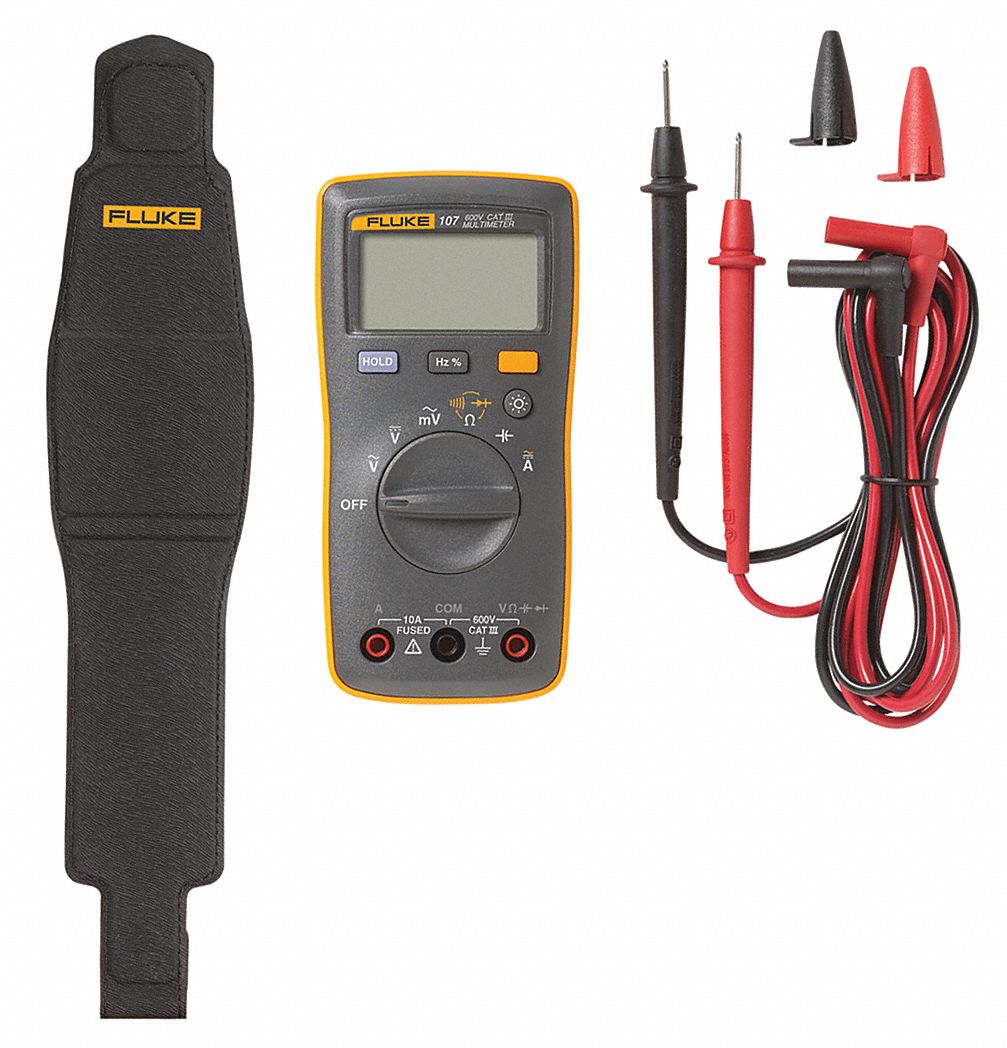
Fluke 107 Pocket Multimeter
A compact CAT III 600V meter for AC/DC voltage, current, resistance, continuity, capacitance, frequency and diode testing. Useful for first-pass power, ground and switch-circuit checks when you have the correct XC60 wiring diagram.
9. Why Disconnecting the Battery Is the Wrong “Alarm Reset”
The old article repeatedly recommended disconnecting the negative terminal for 5–15 minutes to reset the alarm.
That is not a safe universal troubleshooting method.
Volvo explicitly lists starter-battery cable disconnection as an event that can trigger the armed alarm on supported XC60s. Battery disconnection can also remove useful diagnostic context, and it does nothing to repair a failing latch input, movement sensor, siren circuit or wiring fault.
If a temporary power cycle appears to stop the problem, scan the car and diagnose why the fault occurred. Do not convert a temporary disappearance into proof that the problem was “software.”
10. How to Stop the Alarm When It Is Sounding
On current XC60s, Volvo says unlocking the vehicle stops the alarm sound and flashing lights.
If the key buttons do not work on supported newer XC60s, Volvo provides a manual disarm path using the backup key reader in the center-console cup holder. Keep other keys, metal objects and electronics away from the reader because Volvo says they can interfere with key recognition.
Do not assume a long press on Unlock is a universal alarm-reset command. Follow the exact model-year owner manual.
11. How to Use Reduced Alarm Level / Reduce Alarm Sensitivity
This is the cleanest way to test whether interior movement/tilt sensing is behind the unwanted triggers.
| XC60 Era | Volvo Function | What It Does |
|---|---|---|
| First-generation XC60 | Reduced guard / Reduced alarm level | Temporarily deactivates movement and tilt detectors on equipped cars |
| 2018–2021 SPA XC60 | Reduced Guard in center-display Function view | Switches movement/tilt sensing off for the next locked period |
| 2026 XC60 | Settings → Controls → Locking → Reduce alarm sensitivity | Reduces alarm sensitivity for expected movement; resets off with a new driving session |
If false alarms occur with normal sensitivity but disappear every time Reduced alarm level is used, focus diagnosis on movement/tilt conditions or the related sensing system—not the door latch or siren first.
12. Why the XC60 Alarm Seems to Go Off More at Night
Nighttime itself does not activate a special “more sensitive” alarm mode.
A repeatable nighttime pattern can still provide useful clues:
- Colder temperatures can expose a marginal 12V battery or connection.
- Parking climate/heater airflow can create interior movement on applicable sensors.
- Windows/roof left slightly open can allow air currents inside.
- The same trigger may simply be more noticeable when the environment is quiet.
The old article also blamed home Wi-Fi, garage-door openers and smart-home electromagnetic interference. There is not enough Volvo evidence to present that as a standard XC60 false-alarm cause, so that advice has been removed.
13. What About Wind, Trucks, Cats or Branches?
Use the actual sensor design to answer this.
An interior movement detector reacts to movement inside the passenger compartment. Volvo specifically documents air currents inside the cabin as a potential trigger. A tilt sensor reacts to meaningful change in vehicle inclination.
Therefore, a truck passing nearby or an animal merely walking beside the vehicle should not automatically be blamed. If outside vibration appears to correlate with false alarms, test Reduced alarm sensitivity and scan the system rather than assuming the sensor is simply “too sensitive.”
14. 2010 Volvo XC60 Alarm Keeps Going Off: What to Check First
The old article called the 2010 XC60 “alarm-happy.” That claim was not supported.
A better first-generation checklist is:
Empty the Center-Console Cup Holder
Volvo documentation for this generation warns that metal objects near a sensor beneath the cup holder can cause accidental alarm activation.
Close Windows and Roof Fully
Interior movement sensors can register air currents.
Use Reduced Alarm Level for a Test Cycle
If the problem stops, focus on movement/tilt sensing and interior conditions.
Check Latch Status
Watch door/hood/tailgate status with a Volvo-capable scan tool where possible.
Scan for Alarm-System Faults
If the display reports an alarm-system fault, use Volvo-specific diagnosis instead of changing the siren from guesswork.
15. 2018–2021 XC60: SPA Alarm Differences
Second-generation SPA XC60s use a different network and center-display interface from the first generation.
Volvo’s documentation for this era states that movement/tilt sensing can be disabled through Reduced Guard in the center display. If a system fault is detected, the driver display can show Alarm system failure Service required.
Do not use first-generation UEM or cup-holder-sensor assumptions as universal diagnoses for SPA cars.
16. Current 2026 XC60: What Changed?
Current XC60 support describes automatic alarm arming when the vehicle is locked and disarming when unlocked with the standard key/key tag. It also provides a dedicated Reduce alarm sensitivity setting under the Locking controls on 2026 support documentation.
Current XC60 software is updated primarily over the air, with some updates available only through workshops. However, Volvo’s 2026 release notes do not justify blaming every false alarm on “outdated firmware.” Check software as part of diagnosis, not as the default explanation.
17. A 7-Step False-Alarm Diagnostic Workflow

Confirm What the Alarm Did
After disarming, check the alarm indicator and note whether there was sound, hazard flashing or an alarm-system message.
Eliminate Real Trigger Conditions
Close all openings, windows and roof; remove moving items; and empty the older-car cup-holder area of metal objects.
Test Reduced Alarm Sensitivity
Use the correct reduced-alarm function for one or more parking cycles and compare behavior.
Scan the Body/Alarm Systems
Save complete DTCs and live latch/sensor status before clearing anything.
Check 12V Power if Other Electrical Symptoms Exist
Test battery condition, starting/charging behavior and connections rather than relying on one resting-voltage number.
Inspect the Circuit Named by the Evidence
Latch connector, movement/tilt sensor, siren circuit, power/ground or wiring—do not shotgun parts.
Verify Over Several Lock Cycles
After repair, park in the same conditions that previously triggered the alarm and confirm it remains stable.
When to Stop DIY Troubleshooting
- The driver display says Alarm system failure Service required.
- The alarm repeatedly triggers with Reduced alarm sensitivity active.
- Latch status changes in live data but wiring access is difficult.
- There are network/CEM/body-module communication faults.
- The siren circuit or internal siren battery is suspected.
- Water intrusion has reached body-control wiring/modules.
- The problem began after body repair and connector/harness diagnosis is required.
- The vehicle requires VIDA-level fault tracing or software.
Related XC60 Guides
💡 Evans Torres Tip: On every Volvo I have owned, I always keep a full digital service record from day one. When something goes wrong — and eventually something always does — having that history makes diagnosis faster and often saves money at the mechanic. Start your records today, even if the car is not new.
Frequently Asked Questions
First rule out a real alarm input: door/hood/tailgate status, interior movement, tilt, open windows/roof and alarm-system faults. On older XC60s, Volvo also warns about metal objects near the center-console cup-holder sensor. Scan the system if the trigger is not obvious.
Low or unstable 12V power can contribute to broader electrical/module problems, so test the battery when false alarms occur with slow starting or other electrical warnings. Do not assume a weak battery from the alarm alone.
On current XC60s, Volvo says unlocking the vehicle stops a triggered alarm. If the key buttons do not work on a supported newer vehicle, follow Volvo’s backup-reader procedure for the exact model year.
On current 2026 XC60 support, go to Settings → Controls → Locking → Reduce alarm sensitivity. Older XC60s use Reduced alarm level/Reduced Guard procedures that vary by generation.
Yes on XC60s equipped with an interior movement detector. Volvo states that air currents can be registered as movement, which is why it recommends closing windows/roof or using reduced alarm level where appropriate.
Do not assume the 2010 model is inherently defective. On first-generation XC60 documentation, Volvo specifically warns about metal items near a sensor beneath the center-console cup holder and also documents interior air-current triggers. Check those conditions, latch status and alarm DTCs first.
It is not a recommended universal alarm repair. Volvo lists starter-battery cable disconnection as an event that can trigger an armed alarm on supported XC60s. Diagnose the actual trigger instead.
It means the vehicle has detected an alarm-system fault. Volvo recommends workshop diagnosis rather than owner modification of the alarm components.
There is not enough Volvo documentation to treat ordinary home Wi-Fi or garage-door radio interference as a standard XC60 false-alarm cause. Start with documented alarm inputs and diagnostic faults instead.
Use a scanner that can access Volvo body/security systems, not only generic engine codes. Exact coverage varies by year and tool. VIDA is Volvo’s manufacturer-level diagnostic and service-information platform.
Sources & Verification
Primary and Current Sources Used for This Updated Alarm Guide
- Volvo Support US — Current XC60 Alarm Triggering and Alarm Indicator
- Volvo Support US — Current XC60 Activating/Deactivating Alarm and Backup Reader
- Volvo Support — 2026 XC60 Reduce Alarm Sensitivity
- Volvo Support US — First-Generation XC60 Alarm, Interior Airflow and Cup-Holder Metal Warning
- Volvo Support US — First-Generation XC60 Reduced Alarm Level
- Volvo Support — SPA XC60 Alarm System Failure / Movement and Tilt Sensors
- Volvo Support — XC60 Alarm Siren Has Independent Battery
- Volvo Support US — 2026 XC60 Software Release Notes
- Volvo Tech Info — VIDA Vehicle Information & Diagnostics for Aftersales
- Clore Automotive — SOLAR BA9 Battery and System Tester
- WD-40 — Specialist Contact Cleaner
- Fluke — 107 Pocket Digital Multimeter
Final Thoughts
A Volvo XC60 alarm that keeps going off becomes much easier to diagnose when you stop treating every false alarm as the same problem.
First decide whether a monitored opening, interior movement or tilt condition could actually be triggering the system. Use Reduced alarm level as a controlled test. On first-generation cars, do not overlook Volvo’s cup-holder metal warning. Then scan the body/alarm systems and check 12V power only when the wider symptoms support that branch.
Do not use battery disconnection, random sensor replacement or unsupported Wi-Fi theories as shortcuts. The goal is to identify the exact trigger the car is seeing and repair that input.
My Top Picks at a Glance
For this alarm-specific keyword, these three tools cover the most useful diagnostic branches without repeating the scanner/battery products from recent articles: Volvo body-system scanning, proper 12V battery-system testing and premium electrical circuit checks.
TOP VOLVO BODY-DIAGNOSTIC PICK
FOXWELL NT530 for Volvo
A Volvo-specific full-system scanner with body/chassis/powertrain access and supported active tests. It is the most relevant pick here when the alarm fault requires latch, body or security-system DTCs beyond generic OBD2.
BATTERY SYSTEM TEST PICK
Clore SOLAR BA9
A compact 40–1200 CCA 12V battery tester with starting and charging-system tests. Better than relying on one resting-voltage number when alarm problems appear with broader low-voltage symptoms.
PREMIUM ELECTRICAL TEST PICK
Fluke 107 Pocket Multimeter
A compact professional-quality meter for voltage, resistance and continuity checks when diagnosing alarm-related power, ground or latch-switch circuits with the correct XC60 wiring information.
