


If your Volvo XC60 won’t start, the fastest diagnosis starts with the symptom: is the car completely dead, does it click without cranking, does it crank normally but never fire, or does it show a key/battery/system message? Those four situations point to very different problems.
A weak 12V battery is common, but it is not the only cause. Starter-circuit faults, key recognition, fuel/ignition problems, low system voltage, blown fuses, communication faults and—on newer mild-hybrid or plug-in-hybrid XC60s—additional electrical-system issues can all create a no-start condition.
This updated guide removes the one-size-fits-all “replace the battery/starter/fuel pump” advice from the older version and replaces it with a symptom-based process that works across older XC60s, second-generation SPA models and current 2026 XC60s.
If your XC60 is completely unresponsive or rapidly clicks, check the 12V battery and its connections first. If the dashboard has power but the engine does not crank, check the exact driver-display message, key recognition, brake/start inputs and starter circuit. If the engine cranks normally but does not start, scan for engine/immobilizer faults and test fuel, ignition and position-sensor data before replacing parts. On current mild-hybrid XC60s, do not touch or jump from the 48V battery; Volvo says the 48V system must be handled by qualified technicians.
- No power at all: think discharged 12V battery, loose connections, main fuse/power-delivery fault or another electrical problem.
- Rapid clicking: low 12V voltage or poor battery connections are more likely than immediately condemning the starter.
- Single click / no crank: battery condition still matters; then investigate starter circuit, relay/control and mechanical starter faults.
- Cranks normally but will not fire: move toward fuel, spark/injection, crank/cam signal, immobilizer and engine-management diagnosis.
- “Vehicle key not detected”: use the backup key reader rather than assuming the key must be reprogrammed.
- Current 2026 XC60: the 12V battery powers the main electrical system; mild-hybrid versions also have a 48V system that must not be used for jump-starting.
- Plug-in hybrid warning: the gasoline engine can remain off even when the vehicle is successfully started and ready to drive.
- Do not parts-swap from one symptom: save diagnostic codes before clearing or replacing components.

Volvo XC60 Won’t Start: Diagnose It by What the Car Does
The symptom matters more than the model-year stereotype.
| What Happens When You Try to Start | Check First | Most Useful Direction |
|---|---|---|
| No lights, no display, no response | 12V battery, terminals, power supply/fuses | Discharged/failed battery or electrical power-delivery fault |
| Rapid clicking | Battery state, cable/terminal voltage drop | Weak battery or high-resistance connection |
| One click, engine does not crank | Battery under load, starter circuit, starter/solenoid | Starter circuit or starter after voltage is verified |
| Dashboard works but nothing happens | Driver message, key recognition, brake input, start authorization | Key/immobilizer, control input, starter-control or module fault |
| Cranks normally but will not start | Full scan, fuel pressure, ignition/injection, crank/cam signal | Fuel, ignition, sensor or engine-management issue |
| Starts with a jump, later will not restart | Battery health and charging system | Weak battery, charging problem or parasitic draw |
| “Vehicle key not detected” | Backup key reader | Key battery/interference/key recognition issue |
| PHEV shows Ready but gasoline engine stays off | Confirm vehicle is actually in Ready state | Can be normal electric-mode behavior |

1. Weak or Discharged 12V Battery
The 12V battery is the first place to look when the XC60 is completely dead, cranks slowly, rapidly clicks or shows several electrical symptoms at once.
Volvo’s current XC60 documentation says the 12V battery powers the vehicle’s main electrical functions. If its state of charge falls too low, electrical features can be reduced or disabled and the vehicle may need an external charger or jump-start.
Signs That Point Toward the 12V System
- Instrument panel or center display does not wake normally
- Rapid clicking during the start attempt
- Headlamps/interior lights dim heavily during start
- Slow or inconsistent cranking on applicable older engines
- Multiple unrelated low-voltage/communication fault codes
- Vehicle starts with external 12V assistance but later struggles again
A resting-voltage number alone does not tell you battery state of health. A battery can show reasonable open-circuit voltage and still collapse under starting load. Battery condition, cranking behavior, charging performance and connection voltage drop all matter.
Test the Battery Before Replacing It

TOPDON BT200 Battery Tester
TOPDON lists battery health, state-of-charge, cranking and charging tests for supported lead-acid batteries. It is more useful than replacing an XC60 battery from a single voltage reading.
2. How to Jump-Start a Volvo XC60 Safely
Use the jump-start instructions for your exact model year. Volvo changed battery layouts and electrical architectures across XC60 generations.
For the current XC60, Volvo instructs owners to use the vehicle’s designated 12V charging terminals, keep the vehicle switched off while connecting, verify the clamps are secure, and use an external 12V source. If the first start attempt fails, Volvo says to continue charging for about 10 minutes before trying again.
Current mild-hybrid XC60s have a 48V system that supports engine starting and regenerative braking. Volvo explicitly says never to use the 48V battery to jump-start another vehicle and not to connect external equipment to it.
After a successful jump-start, Volvo says the 12V battery charges better while the vehicle is being driven. If the same battery quickly goes flat again, diagnose battery health, charging and parasitic drain rather than repeatedly jump-starting it.
Roadside Option: Portable 12V Jump Starter
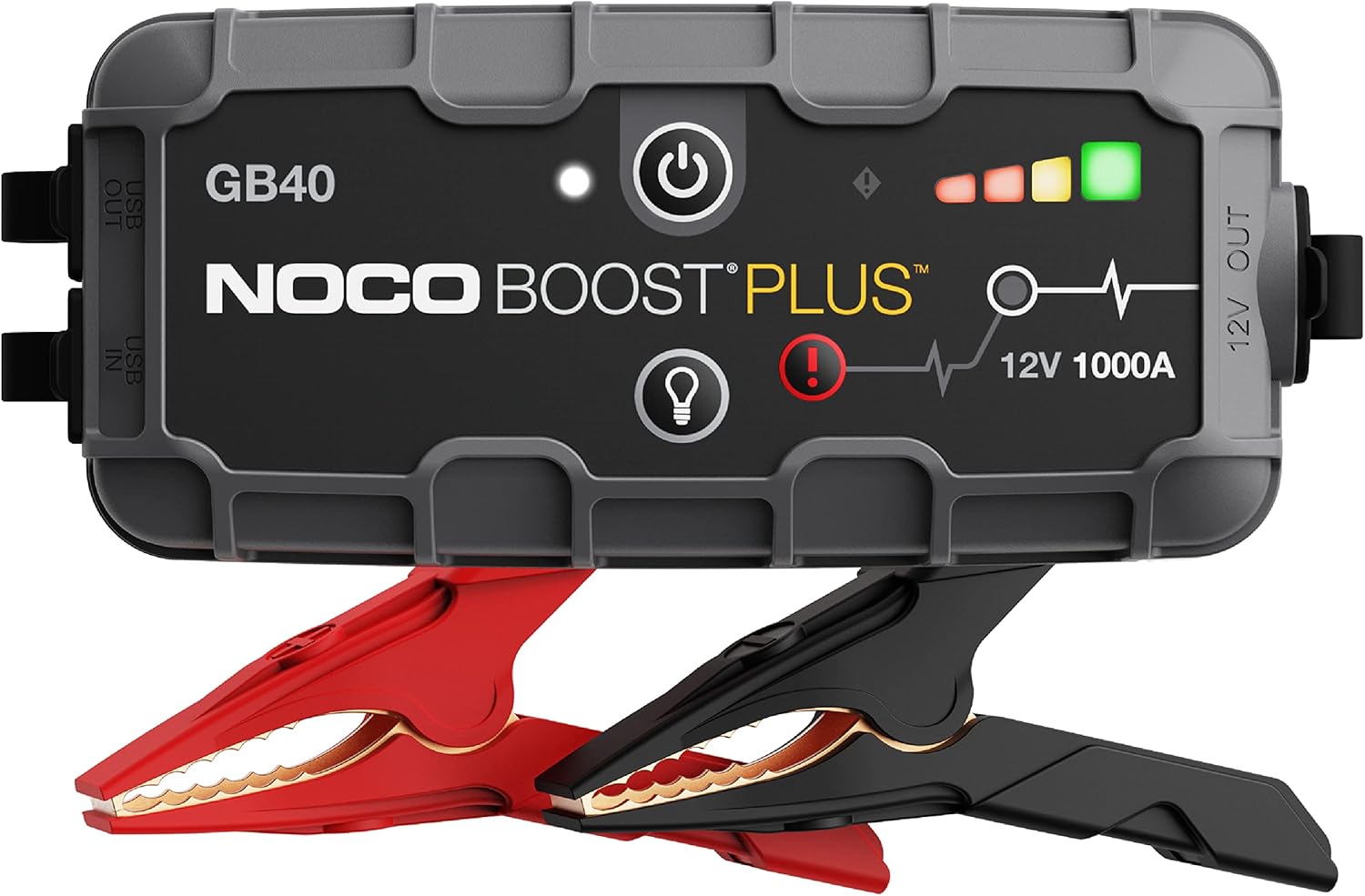
NOCO Boost GB40
NOCO rates the GB40 at 1,000A for 12V lead-acid batteries, with gasoline-engine coverage up to 6.0L and diesel coverage up to 3.0L. That comfortably covers XC60 engine displacement, but always follow Volvo’s designated jump points and the jump starter’s instructions.
3. Rapid Clicking vs One Click: Don’t Replace the Starter Too Fast
Clicking does not automatically mean “bad starter.”
Rapid Repeated Clicking
This commonly points toward insufficient voltage reaching the starter system. Check the 12V battery under load, battery terminals and major grounds first.
One Solid Click With No Crank
A starter/solenoid problem becomes more plausible, but first prove that battery voltage and current delivery are good. A poor cable or weak battery can still produce a single click.
No Click at All
Move upstream: start authorization, brake-pedal input, key recognition, starter relay/control, fuses and network/module faults can all prevent a start request from reaching the starter system.
Working under the vehicle to hit a starter is not a useful modern diagnostic method and can create safety risk. Verify the electrical command and voltage-drop path instead.
4. “Vehicle Key Not Detected” or Key Recognition Problems
A weak key battery can affect normal keyless detection, but it does not automatically mean the vehicle needs key programming.
On current XC60s, Volvo provides a backup key reader in the center-console cup holder. If the standard key or Key Tag is not being detected normally, place the key on the backup-reader symbol and make a new start attempt.
Keep other keys, metal objects and electronics such as phones or chargers away from the backup reader because Volvo says they can interfere with key recognition.
The detachable mechanical key blade can help you open the driver door, and the backup key reader can still be used to deactivate the alarm and authorize starting on supported current XC60s.
For key replacement/battery details, see Volvo Car Key Replacement and How to Get a New Volvo Car Key.
5. XC60 Cranks but Won’t Start
If the engine turns over at normal speed but never starts, the 12V battery and starter have already moved lower on the suspect list.
Now investigate whether the engine has the inputs required for combustion:
- Fuel pressure and injector operation
- Ignition/spark on gasoline engines
- Crankshaft and camshaft position signals
- Correct immobilizer/start authorization
- Airflow/pressure sensor data
- Engine-control-module power and communication
- Timing/compression if electrical and fuel tests are normal
Listening for a fuel-pump sound is not enough to condemn or approve the pump. Test fuel pressure or requested/actual fuel data according to the exact engine.
6. Ignition Coils, Spark Plugs and Misfire-Related No-Start
On gasoline XC60s, worn plugs or failed coils more commonly create misfires, rough running and hard starting than a total no-start—but severe ignition problems can prevent normal starting.
Scan misfire data before replacing a complete set of coils. If one cylinder is consistently involved, compare ignition, injector and compression information.
7. Crankshaft or Camshaft Position Sensor Faults
A missing crank/cam signal can prevent the engine control module from synchronizing fuel and ignition.
Do not replace a position sensor from one generic code alone. Inspect wiring/connectors and use live data to confirm whether engine-speed and synchronization signals are present while cranking.
8. Starter/Charging Electrical Faults After a Jump-Start
If the XC60 starts with external power but dies later or will not restart, the problem may be:
- A 12V battery that cannot retain sufficient charge
- A charging-system fault
- Loose/corroded battery connection
- Parasitic drain while parked
- A broader electrical or software fault preventing correct charging
Do not assume “it started with a jump, so the alternator is bad.” Test the battery and charging system.
9. Current 2026 XC60: 12V and 48V Systems
Current mild-hybrid XC60s use more than one voltage system.
| System | Role | Owner Guidance |
|---|---|---|
| 12V battery | Powers main electrical functions | Can be charged externally/jump-started through the designated 12V procedure |
| 48V mild-hybrid system | Supports engine starting and regenerative braking | Do not jump from it or connect external equipment; service by qualified technicians |
Volvo’s current U.S. XC60 support page lists an H7 AGM 12V battery specification for the current vehicle, but that specification should not be applied automatically to older XC60s. Use the VIN/model-year battery specification when replacing any battery.
10. XC60 Plug-In Hybrid: The Gasoline Engine Can Stay Off Normally
On an XC60 plug-in hybrid, a quiet gasoline engine does not necessarily mean the vehicle failed to start.
Volvo says the vehicle normally prioritizes the electric motor, so the gasoline engine may remain off while the vehicle is ready to drive. The gasoline engine can start later because of low temperature, traction-battery needs or other operating conditions.
If the vehicle is completely unresponsive, Volvo notes that a discharged 12V battery can prevent unlocking or starting even when the vehicle also has a high-voltage traction battery.
Do not open or service high-voltage PHEV battery components as part of a no-start diagnosis. A normal 12V jump procedure and a high-voltage traction-battery repair are completely different tasks.
11. Full-System Scan Before Replacing Expensive Parts
Modern XC60s contain multiple control modules. A basic engine-code reader can help with generic emissions faults, but it may miss body, battery, immobilizer and communication information that is directly relevant to a no-start.

iCarsoft VOL V3.0 for Volvo/Saab
iCarsoft describes the VOL V3.0 as a Volvo/Saab multi-system scanner that can scan supported vehicle systems, read/clear DTCs and display live data. Exact no-start coverage depends on the model year and control system.
12. A 7-Step XC60 No-Start Diagnostic Workflow

Classify the Symptom
No power, rapid click, one click/no crank, normal cranking/no start, or key/system warning. Do not skip this step.
Read the Driver Display
Current Volvo systems often tell you why start authorization is blocked. Record the exact message instead of paraphrasing it.
Check the 12V System
Inspect battery connections and test state of charge/health. If voltage is too low, use the model-specific charge or jump-start procedure.
If the Key Is Not Detected, Use the Backup Reader
Keep other keys/metal/electronics away from the reader and try again before assuming immobilizer failure.
Scan the Vehicle
Save active and stored faults from engine, central electronics, key/security and hybrid systems where applicable.
Test the System Indicated by the Symptom
Starter voltage drop for no-crank; fuel/ignition/crank signal for crank-no-start; charging/parasitic drain after repeated battery discharge.
Repair the Root Cause and Verify
Clear faults only after saving them, then confirm the XC60 starts repeatedly without external assistance and no related warning returns.
13. Older XC60 vs Newer XC60 No-Start Differences
| XC60 Type | Important Differences |
|---|---|
| First-generation XC60 | Traditional starter-battery architecture varies by engine/year; some Start/Stop cars use a separate support battery |
| 2018+ SPA XC60 | Passive-start/key backup reader, more networked modules and electronic start authorization |
| Mild-hybrid XC60 | 12V main electrical battery plus 48V system; 48V service is not a DIY jump-start task |
| Plug-in hybrid XC60 | Gas engine may remain off normally in Ready mode; 12V and high-voltage battery conditions require separate diagnosis |
14. Remote Start Not Working Is Not the Same as the XC60 Not Starting
If the XC60 starts normally from inside the vehicle but remote-start/remote functions do not work, treat that as a separate problem involving app/key connectivity, vehicle conditions or remote-function eligibility.
Do not replace the starter or fuel pump because a remote-start request failed.
If the Volvo Cars app is involved, see Volvo Car App Not Working.
15. When to Call for Professional Diagnosis
- The vehicle repeatedly loses all 12V power after charging/jump-starting.
- The battery and connections test good but the starter never receives/executes the start command.
- The engine cranks normally but fuel/ignition diagnosis requires pressure or waveform testing.
- There are immobilizer or network-communication faults that remain after backup-reader checks.
- A mild-hybrid fault involves the 48V system.
- A plug-in hybrid fault involves high-voltage components.
- The vehicle has burnt wiring, major fuse failure, smoke or overheating electrical connections.
- The same no-start returns after a part was already replaced.
16. Preventing XC60 Starting Problems
No maintenance routine can prevent every no-start, but battery and electrical care reduce avoidable failures.
- Keep the 12V battery charged: Volvo currently recommends at least about 15 minutes of driving per week or automatic maintenance charging when appropriate.
- Avoid long periods of accessory use with the engine off: center display, lighting, climate and USB/12V accessories all use battery power.
- Keep terminals and cables secure: loose/high-resistance connections can mimic battery or starter failure.
- Address repeated low-voltage warnings: do not wait for the vehicle to become unresponsive.
- Use the correct replacement battery: specification varies by generation and powertrain.
- Do not automatically replace batteries by age: Volvo says service life depends on driving conditions and climate; test condition instead.
- Keep a charged jump pack if useful: but learn the XC60’s correct jump points before an emergency.
- Scan intermittent faults before clearing them: fault history is valuable when a no-start comes and goes.

Video: Volvo XC60 No-Start Reference
This video can provide extra visual context, but match the procedure to your exact XC60 model year and powertrain before following electrical or jump-start instructions.
Related Volvo XC60 and Electrical Guides
💡 Evans Torres Tip: On every Volvo I have owned, I always keep a full digital service record from day one. When something goes wrong — and eventually something always does — having that history makes diagnosis faster and often saves money at the mechanic. Start your records today, even if the car is not new.
Frequently Asked Questions
Start with the symptom. No power or rapid clicking usually sends you toward the 12V battery and connections. One click/no crank needs battery and starter-circuit testing. Normal cranking with no start points more toward fuel, ignition, crank/cam signal, immobilizer or engine-management faults.
Rapid clicking commonly indicates low voltage or a poor battery connection. A single click can involve the starter/solenoid, but the battery and high-current connections should be tested before replacing the starter.
Dashboard power does not prove the battery can supply starting current. Also check the exact driver message, key recognition, brake/start inputs, starter-control circuit and stored faults.
On supported current XC60s, place the key on the backup key reader in the center-console cup holder and try again. Keep other keys, metal objects and electronics away from the reader.
Normal keyless detection may fail, but supported XC60s have a backup reader that can recognize the key at close range. Try the backup-reader procedure before assuming the key or immobilizer needs reprogramming.
Yes, Volvo provides a 12V jump-start procedure using the designated charging terminals and an external 12V source. On a mild-hybrid XC60, never connect jump-start equipment to the 48V battery.
The 12V battery may be weak, the charging system may not be maintaining it, a connection may have excessive resistance, or the vehicle may have a parasitic/electrical fault. Test the battery and charging system instead of repeatedly jump-starting.
Check for stored faults, fuel pressure/injection, ignition on gasoline engines, crank/cam position signals, immobilizer authorization and engine-management power/communication.
Not necessarily. Volvo says an XC60 plug-in hybrid normally prioritizes electric drive, so the gasoline engine can remain off while the vehicle is successfully started and ready to drive.
Volvo does not give one universal replacement age. Battery life depends on driving conditions, climate, discharge history and charging. Test the battery’s condition and replace it with the exact type/capacity required for the vehicle when needed.
Sources & Verification
Primary Sources Used for This Updated XC60 No-Start Guide
- Volvo Support US — Current XC60 Jump-Starting Procedure
- Volvo Support US — Current XC60 Starting the Vehicle
- Volvo Support US — Current XC60 12V Battery
- Volvo Support US — XC60 48V Battery Safety
- Volvo Support US — Backup Key Reader and Detachable Key Blade
- Volvo Support US — XC60 Plug-In Hybrid Starting Behavior
- Volvo Support US — XC60 Plug-In Hybrid No-Power Recovery
- iCarsoft — VOL V3.0 Volvo/Saab Diagnostic Coverage
- TOPDON — BT200 Battery/Cranking/Charging Tests
- NOCO — Boost GB40 Specifications
Final Thoughts
A Volvo XC60 that won’t start is much easier to diagnose when you stop treating every no-start as the same problem.
Start by deciding whether the vehicle has no electrical power, clicks without cranking, cranks normally but does not fire, or is refusing start authorization because of a key/system condition. That first distinction prevents most unnecessary parts replacement.
For current XC60s, remember the electrical architecture too: the 12V system is still essential to vehicle operation, while mild-hybrid models add a 48V system that requires different safety rules. Plug-in hybrids can also be successfully “started” without the gasoline engine running.
Test before replacing. Save fault codes before clearing. And when the problem involves 48V/high-voltage systems, immobilizer programming or complex network faults, use a Volvo-capable workshop rather than continuing with trial-and-error repairs.
My Top Picks at a Glance
These three tools match the most useful XC60 no-start checks: battery/cranking diagnosis, emergency 12V starting support and Volvo-specific full-system scanning.
BATTERY DIAGNOSIS PICK
TOPDON BT200 Battery Tester
Useful for battery health, state-of-charge, cranking and charging tests when the XC60 is dead, slow to start or repeatedly needs a jump.
ROADSIDE 12V PICK
NOCO Boost GB40
A 1,000A portable 12V jump starter rated for gas engines up to 6.0L and diesels up to 3.0L. Use only with the XC60’s designated 12V jump points and correct model-year procedure.
VOLVO DIAGNOSTIC PICK
iCarsoft VOL V3.0
A Volvo/Saab-focused multi-system scanner for supported DTCs, system scans and live data—more relevant to modern XC60 no-start diagnosis than a basic engine-only reader.
