


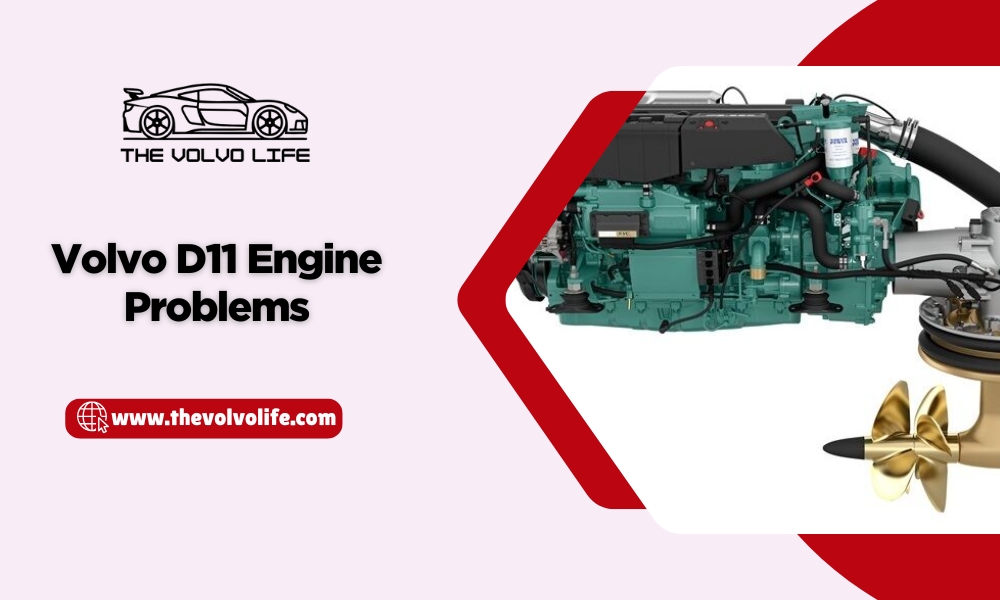
Volvo D11 engine problems usually show up as power loss, derate warnings, repeated DPF regeneration, excessive smoke, overheating, hard starting, poor fuel economy or fault messages. But those symptoms do not automatically mean the base engine is failing.
On a modern Volvo truck, the D11 works as part of a complete system that includes fuel injection, turbocharging, charge-air plumbing, EGR, DPF, SCR/DEF, sensors, electrical controls and the truck’s diagnostic network. A fault in any one of those systems can make the engine feel weak or unreliable.
This updated guide separates the symptoms, explains the safest diagnostic order, corrects several outdated repair shortcuts, and shows when the problem is likely to be aftertreatment, cooling, fuel, turbo/boost, electrical—or a deeper engine issue.
If your Volvo D11 loses power or shows an engine/aftertreatment warning, do not start by replacing injectors, the turbo or the DPF. Record the exact warning, scan the truck for active and inactive faults, check live data, inspect the cooling and charge-air systems, verify fuel delivery, and follow the truck’s regeneration instructions if the DPF system requests it. If soot level is critical or regeneration cannot complete, Volvo’s driver guidance says to contact a workshop.
- D11 truck specs: Volvo Trucks currently lists the D11 in VHD applications from 325 to 425 hp, with up to 1,550 lb-ft of torque.
- DPF/SCR faults can mimic engine failure: aftertreatment restrictions and derate logic can cause severe power loss even when the base engine is mechanically healthy.
- Do not force random regens: use the driver display/diagnostic procedure when regeneration is requested and the required conditions are met.
- Do not use a fixed oil interval from a generic article: follow the maintenance schedule for your exact truck, engine generation, oil specification and duty cycle.
- Do not delete DPF/EGR/SCR systems: U.S. EPA rules prohibit tampering with required emissions controls.
- Volvo Penta D11 is not the same application: the current marine D11 is a 10.8-liter engine offered in much higher marine power ratings, so truck troubleshooting and service intervals should not be copied directly to marine installations.
Volvo D11 Engine Problems: Symptom-to-Cause Table
Start with what the truck is doing instead of guessing the failed part.
| Symptom | Most Useful First Checks | Possible Systems Involved |
|---|---|---|
| Loss of power / derate | Scan faults, check aftertreatment status, boost/charge-air data and fuel pressure | DPF/SCR, EGR, turbo/VGT, charge-air leak, fuel system, sensors |
| Frequent regeneration | Check soot load, DPF differential pressure, exhaust temperatures and fault history | DPF, sensors, injectors, EGR, duty cycle, exhaust leaks |
| Black smoke | Air filter, boost leak, turbo/VGT, EGR flow, fueling | Air/fuel imbalance, charge-air system, turbo, injector issue |
| White smoke | Check operating temperature, coolant loss, injector balance and startup conditions | Incomplete combustion, fuel issue, coolant intrusion in serious cases |
| Blue/gray oil smoke | Oil consumption, turbo seals, crankcase pressure and mechanical condition | Turbo, rings/liners, valve train, crankcase ventilation |
| Overheating | Coolant level, leaks, fan operation, radiator/charge-air cooler cleanliness, water pump/thermostat diagnosis | Cooling system, fan control, coolant leak, airflow restriction |
| Hard start / rough idle | Battery/starting voltage, fuel supply, rail pressure, injector contribution, stored faults | Fuel system, electrical supply, sensors, injectors |
| DEF/SCR warning | Read aftertreatment faults and live data before replacing parts | DEF dosing, NOx sensors, SCR, wiring, quality/temperature issues |
First: Know Which Volvo D11 You Are Diagnosing
The name D11 is used across more than one Volvo application. That matters because specifications, control systems and service procedures are not interchangeable.
| D11 Application | What It Is | Why It Matters |
|---|---|---|
| Volvo Trucks D11 | Heavy-duty truck engine; current VHD page lists 325–425 hp and up to 1,550 lb-ft | This article focuses mainly on the North American truck D11 |
| Volvo Penta D11 Marine | 10.8L marine inboard engine; current variants run from 510 to 725 hp | Marine cooling, controls, loading and maintenance are different |
| Volvo Penta D11 Industrial | 10.8L off-road industrial engine with different emissions/application packages | Do not copy truck intervals or fault logic without checking the industrial manual |
Volvo’s own service resources are organized by truck build year, model and engine. When you are troubleshooting a specific D11, use the exact chassis/VIN-based driver and service information rather than relying on one generic procedure for every D11 ever built.
1. DPF Regeneration Problems and Engine Derate
Repeated regeneration, a DPF warning, reduced power or an aftertreatment derate is one of the first areas to investigate on an emissions-equipped D11.
Volvo’s aftertreatment system uses a DPF to capture particulate matter and SCR/DEF to reduce NOx. A fault in the sensors, dosing system, temperature management or the DPF itself can trigger warnings and reduced performance.
What to Check
- Active and inactive aftertreatment fault codes
- DPF soot level
- DPF differential pressure
- Exhaust gas temperature sensor readings
- Regeneration status and conditions inhibiting regen
- DEF level and relevant SCR/NOx faults
- Whether the truck is actually requesting active/parked regeneration
Do not treat “drive it hard on the highway” as a universal DPF repair. On current Volvo driver guidance, an active regeneration is started through the truck’s maintenance menu when regeneration is required and the listed conditions are satisfied. If soot level is critical or the regeneration system has a malfunction, the display directs the driver to contact a workshop.
Why Regeneration May Keep Returning
A DPF can load again quickly when the root cause is somewhere else. Excess soot can come from poor combustion, boost problems, EGR faults, injector issues or an operating cycle that does not allow the system to manage soot normally. A bad differential-pressure or temperature sensor can also make the system behave as if the filter is the only problem.

ANCEL HD3400 Pro Heavy-Duty Truck Scanner
Useful when you want a portable heavy-duty scanner for code reading, live data and supported DPF functions. ANCEL lists Volvo and Mack truck coverage, but this is not a replacement for Volvo Premium Tech Tool when OEM-level programming or guided diagnostics are required.
2. Loss of Power, Low Boost and Charge-Air Leaks
A D11 that feels weak under load does not automatically need a turbocharger.
Low boost can come from a charge-air leak, loose clamp, split hose, damaged charge-air cooler, exhaust leak before the turbo, VGT control problem, sensor fault, EGR issue or fuel-delivery problem.
A Better Diagnostic Order
Scan the Truck
Record engine, aftertreatment and network faults before clearing anything.
Compare Requested vs Actual Data
Look at boost/intake pressure, turbo actuator or nozzle position where supported, EGR-related values, fuel supply and engine load.
Inspect the Charge-Air System
Check boots, clamps, piping and the charge-air cooler for oil tracks, loose joints or obvious damage.
Test Before Replacing the Turbo
If the turbo/VGT is suspected, verify control, shaft condition, oil supply and related air/exhaust faults before replacing an expensive unit.
If your problem is broader than the D11 and you are troubleshooting a Volvo that loses power under acceleration, see Volvo Loss of Power When Accelerating.
3. Turbocharger / VGT Problems
Turbo-related symptoms can include low power, slow boost response, unusual whistle, black smoke, oil consumption or turbo-control fault codes.
The most useful question is not “Does the turbo make noise?” but “Does the turbo system produce the requested airflow and boost under the conditions commanded by the ECM?”
Volvo’s truck diagnostic tooling can monitor values such as intake manifold pressure, turbo nozzle position, turbo actuator effort and actuator temperature. Those data points help separate a turbo-control fault from a simple boost leak or unrelated derate.
A boost leak, EGR-flow problem, sensor error or aftertreatment derate can make the truck feel like it has a bad turbo. Confirm the system before ordering a turbocharger.
4. Fuel-System and Injector Problems
Hard starting, rough idle, unstable power, poor fuel economy and smoke can point toward fuel delivery or injector problems—but the exact diagnosis should start with data.
Useful Checks
- Fuel supply pressure where supported
- Fuel filter condition and service history
- Water/contamination in the fuel system
- Injector-related fault codes
- Manual injector cut-out/contribution testing with appropriate diagnostic equipment
- Rail/fuel-system data for the exact D11 generation
Avoid pouring random fuel additives into the system as a substitute for diagnosis. Use fuel and treatments that meet the requirements for your specific engine and operating environment.
5. Cooling-System Problems and Overheating
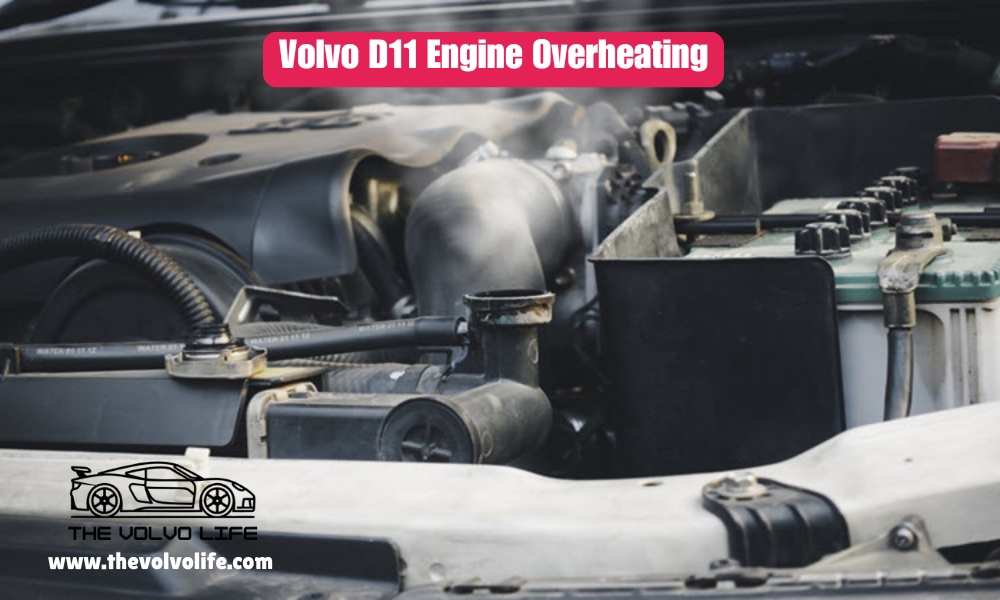
Overheating deserves immediate attention because continued operation at excessive temperature can turn a manageable cooling fault into expensive engine damage.
Check These First
- Coolant level and visible leaks
- Correct coolant type and condition
- Radiator and charge-air cooler airflow restriction
- Fan operation/control
- Thermostat diagnosis
- Water-pump circulation/leakage
- Hoses, clamps and pressure-cap condition
- Evidence of combustion gases or internal coolant loss if no external leak is found
Do not make radiator stop-leak/sealant your default repair. Find the source of the leak and repair the failed component correctly, especially on a commercial engine where cooling reliability is critical.

Klein Tools IR5 Infrared Thermometer
A non-contact IR thermometer can help compare surface temperatures across radiator, charge-air and cooling-system areas during diagnosis. It does not replace the truck’s coolant-temperature sensor data or a proper pressure test.
6. Coolant Leaks, Radiator Leaks and EGR-Cooler Concerns
A puddle under the truck does not automatically mean the radiator itself is leaking. Coolant can escape from hoses, fittings, surge tank, radiator, water pump, heater circuits or other cooling-system components.
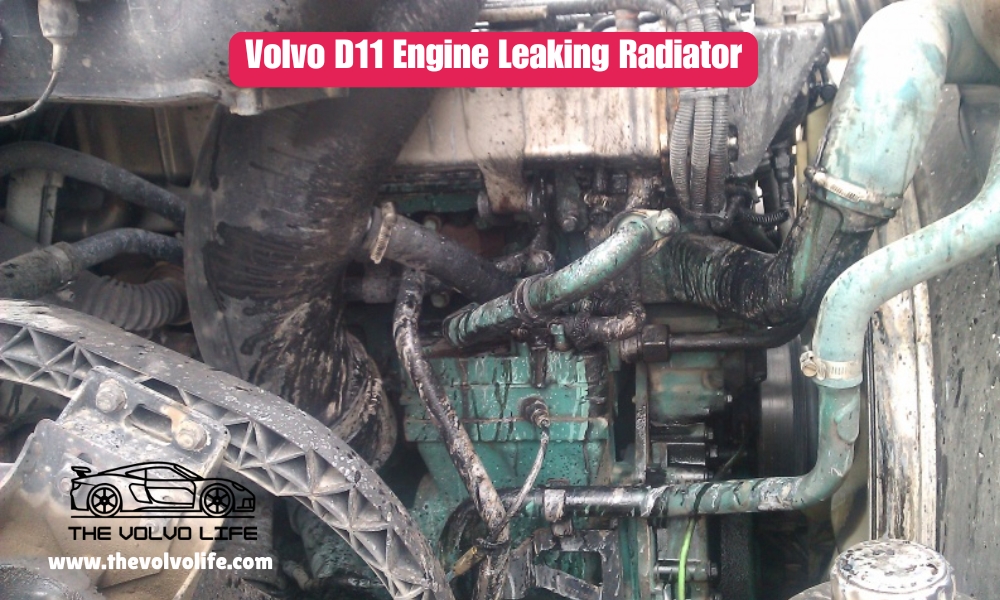
Clean the area, pressure-test the system when appropriate, and identify the actual leak path. If coolant disappears without an obvious external leak, investigate internal leak paths instead of repeatedly topping off the system.
Never open a pressurized cooling system when the engine is hot. Hot coolant and steam can cause severe burns.
7. DEF, SCR and NOx-Sensor Problems
The original article focused heavily on DPF and EGR but barely addressed SCR/DEF. On modern heavy-duty diesel trucks, that is a major gap.
Volvo’s emissions system routes exhaust through the DPF and then uses DEF with the SCR catalyst to reduce NOx. Faults in DEF pressure/dosing, NOx sensors, exhaust temperatures, wiring or catalyst performance can create warnings and derates.
What to Do
- Read the exact SCR/DEF fault codes before replacing a NOx sensor or dosing component.
- Check DEF level and relevant live data.
- Look for wiring/connector issues around hot aftertreatment components.
- Use OEM or capable heavy-duty diagnostics to view aftertreatment status.
- Do not confuse a DEF/SCR derate with a failed base engine.
8. EGR-Related Power and Emissions Problems
EGR faults can affect airflow, combustion and aftertreatment behavior. Symptoms may include power loss, rough operation, excessive soot, warning lights or regeneration problems.
Volvo diagnostic tools can monitor EGR temperature, EGR mass flow, EGR differential pressure and EGR valve position. That is much more useful than simply removing the valve and cleaning it every time a truck loses power.
Do not delete or bypass the DPF, EGR or SCR system on a U.S. road vehicle. EPA guidance states that tampering with required emissions controls and selling/installing defeat devices is prohibited under the Clean Air Act.
9. Electrical, Battery and Sensor Problems
Low system voltage, poor battery connections, alternator problems, damaged harnesses and sensor faults can create engine warnings that look mechanical.
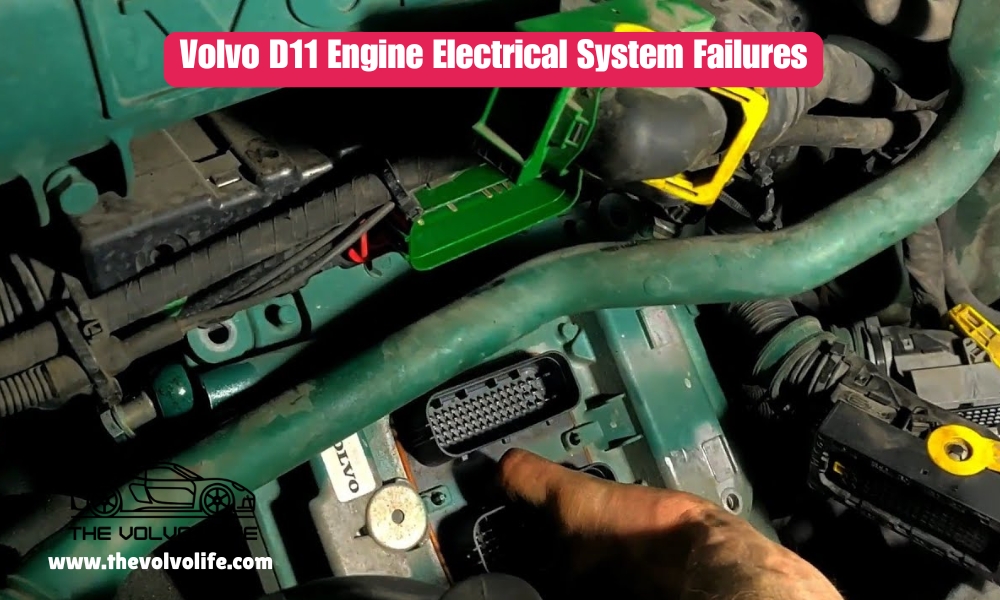
Check the Electrical Basics
- Battery condition and state of charge
- 12V/24V starting and charging system health as applicable
- Battery terminals and grounds
- Alternator output under load
- ECU supply voltage
- Harness damage near heat, vibration or fluid contamination
- Faults that return immediately after clearing
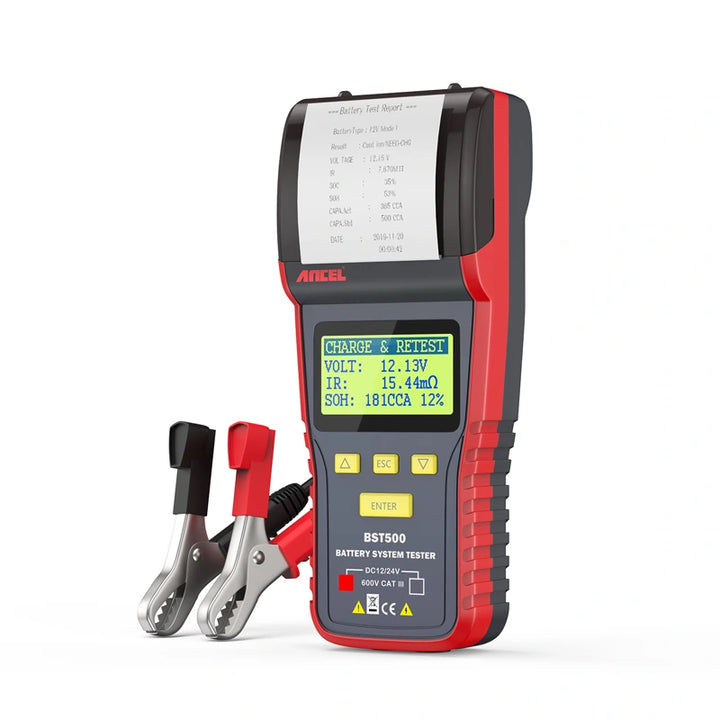
ANCEL BST500 12V/24V Battery Tester
Designed for 12V batteries and 12V/24V starting/charging systems, making it more relevant to heavy-truck electrical checks than a passenger-car-only tester. Always follow the truck manufacturer’s electrical test procedure.
10. Excessive Exhaust Smoke: Black, White or Blue
Smoke color can provide clues, but it is not a complete diagnosis.
| Smoke Color | Possible Direction | What to Verify |
|---|---|---|
| Black | Too much fuel for available air / poor combustion | Boost, charge-air leaks, air restriction, EGR, injectors, turbo control |
| White | Cold/incomplete combustion, fueling issue or possible coolant intrusion | Operating temperature, injectors, coolant loss, startup conditions |
| Blue / gray | Oil entering combustion/exhaust | Oil consumption, turbo seals, crankcase pressure, mechanical wear |
If smoke is heavy, new, persistent or paired with low oil pressure, overheating, coolant loss or engine noise, stop treating it as a minor maintenance issue and have the engine diagnosed.
11. Hard Starting, Rough Idle and Sputtering Under Load
Hard starting and rough running can come from several systems at once: weak electrical supply, fuel restriction, injector imbalance, sensor faults, air in the fuel system or low compression in serious cases.
Sputtering or loss of power uphill is especially useful because the fault appears under load. That is when boost, fuel demand, exhaust temperature and aftertreatment restrictions become easier to expose in live data.
A truck that idles perfectly in the yard can still have a boost leak, fuel-supply problem or aftertreatment restriction that only appears on a grade. Record live data during the actual symptom when it can be done safely.
12. When the Problem May Be Internal Engine Damage
Most power-loss complaints should be diagnosed through fuel, air, cooling, emissions and electrical systems first. But some symptoms justify deeper mechanical testing.
Signs That Need Deeper Mechanical Diagnosis
- Persistent low oil pressure
- Heavy crankcase blow-by
- Rapid oil consumption
- Coolant entering the oil
- Oil entering the coolant
- Repeated unexplained coolant loss with white exhaust
- Knocking or abnormal mechanical noise
- Low compression / poor cylinder contribution after external causes are ruled out
- Metal contamination in oil or filters
Volvo’s own overhaul program lists decreased fuel economy, poor responsiveness, hard starting, excessive oil consumption and excessive exhaust smoke among signs that can justify overhaul evaluation. Those symptoms still need diagnosis before an overhaul decision is made.
Volvo D11 Diagnostic Workflow: What to Do Before Buying Parts
Record the Exact Complaint
Note when it happens: cold start, hot idle, hill climb, loaded acceleration, highway cruise, regeneration or after refueling.
Save Fault Codes Before Clearing
Active/inactive codes, timestamps and fault counts can show whether the problem is current or intermittent.
Review Live Data
Useful data can include coolant temperature, fuel supply, intake pressure/temperature, turbo position, EGR values, DPF pressure, exhaust temperatures, DEF pressure and ECU supply voltage.
Perform Visual and Pressure Checks
Inspect charge-air plumbing, cooling system, fuel system, exhaust leaks, wiring and battery/ground connections.
Run the Appropriate Functional Test
Depending on the fault, this may be injector contribution, DPF service regeneration, turbo/VGT checks, cooling pressure test or electrical system testing.
Repair the Root Cause, Then Verify
Clear codes only after saving the diagnostic information, repair the fault, road-test under the original conditions and confirm the codes/data remain normal.
Volvo Premium Tech Tool vs Aftermarket Heavy-Duty Scanners
Volvo Trucks offers Premium Tech Tool (PTT) for deeper testing, calibration and programming. Volvo also describes truck diagnostic tools that can read/clear faults, view sensor data, perform manual injector cut-out, monitor aftertreatment and perform supported DPF service regeneration.
| Tool Type | Best For | Limitations |
|---|---|---|
| Volvo Premium Tech Tool | OEM-level Volvo/Mack diagnostics, programming, calibration and guided procedures | Higher cost and more professional setup |
| Heavy-duty aftermarket scanner | Portable DTCs, live data, supported system tests and road-side troubleshooting | Coverage and special functions vary by truck/year |
| Basic generic OBD reader | Limited standard code access | Often inadequate for heavy-duty Volvo engine/aftertreatment diagnosis |
2013 vs 2016 Volvo D11 Problems: Do Not Diagnose by Model Year Alone
The old article treated 2013 and 2016 as if there were a simple list of “fixed” and “not fixed” D11 problems. That is too broad.
Two D11 trucks can have different emissions generations, calibrations, service history, duty cycles, wiring changes and previous repairs. Volvo itself organizes driver/service information by build year, model and engine.
If you are shopping for a used 2013 or 2016 D11, service records and a complete diagnostic scan are more useful than assuming one year is automatically trouble-free.
Used D11 Pre-Purchase Checks
- Full active/inactive fault report
- Aftertreatment history and soot/regen behavior
- Oil consumption history
- Coolant-loss history
- Cold-start behavior
- Blow-by / crankcase pressure condition
- Boost and charge-air integrity
- Injector/fuel-system history
- Maintenance records and oil specification
- ECM/software update history where available
Is the Volvo D11 a Good Engine?
For the right application, the D11 has a strong case. Volvo positions it as a lighter engine with high power density; in current VHD material, it is listed from 325 to 425 hp and up to 1,550 lb-ft while weighing substantially less than the D13.
That makes it attractive where weight and regional/vocational efficiency matter. But reliability depends heavily on duty cycle, maintenance and the health of the emissions/fuel/air systems around the engine.
It is more accurate to say the D11 can be a good engine when correctly specified and maintained than to promise a universal lifespan such as 800,000–1,200,000 miles. Actual service life varies too much by application and maintenance history for one mileage number to be reliable.
For a deeper dedicated answer, read Is the Volvo D11 a Good Engine?.
Volvo D11 vs D13: Which One Fits the Job?
The D11 is the smaller, lighter option. The D13 offers more displacement and higher power/torque potential for heavier applications.
| Category | D11 | D13 |
|---|---|---|
| Displacement class | 11-liter class | 13-liter class |
| Current VHD power range | 325–425 hp | Higher-output choices available, up to 500 hp on current VHD material |
| Current VHD max torque mentioned | Up to 1,550 lb-ft | Up to 1,850 lb-ft |
| Best fit | Weight-sensitive regional/vocational applications | Applications needing greater horsepower/torque reserve |
Volvo D11 Marine Engine Problems: Keep Volvo Penta Separate
The original article mixed truck and marine D11 advice. The engines share Volvo heritage, but a Volvo Penta D11 marine installation operates in a very different environment.
Volvo Penta’s current D11 inboard lineup is a 10.8-liter inline-six offered in 510, 625, 670 and 725 hp ratings. It uses marine-specific cooling, controls and installation hardware.
Marine-Specific Areas to Watch
- Heat-exchanger and seawater-side cooling performance
- Impeller/seawater-pump condition where applicable
- Marine fuel contamination and water separation
- Corrosion and salt exposure
- Turbo/charge-air performance under sustained marine load
- Electronic Vessel Control faults
Use the Volvo Penta operator manual and service schedule for the exact D11 marine rating. Do not copy truck oil, aftertreatment or regeneration advice into a marine maintenance plan.
Volvo D11 Maintenance: What Actually Helps Prevent Problems?
Preventive maintenance matters, but fixed intervals copied from another truck can be misleading.
Volvo provides truck-specific service charts and adaptive maintenance options based on actual vehicle use. Follow the schedule for your build year, engine, oil specification and operating condition.
| Maintenance Area | What Matters |
|---|---|
| Engine oil and filters | Correct Volvo-approved oil specification and interval for duty cycle |
| Fuel system | Clean fuel, correct filters, water management and contamination control |
| Cooling system | Correct coolant, leak checks, airflow and service intervals |
| Charge-air system | Hose/clamp inspection, cooler integrity and leak diagnosis |
| Aftertreatment | DPF/SCR maintenance, correct DEF and prompt attention to warnings |
| Electrical | Battery/charging condition, grounds, harness inspection |
| Software / diagnostics | Keep software current and investigate recurring faults before they become derates |
Do not replace “Volvo schedule” with a fixed internet interval. Volvo’s current service approach includes OEM-recommended and adaptive maintenance based on utilization.
When to Stop Driving and Get Professional Help
- The truck has a severe derate or requests immediate regeneration/workshop service.
- Soot level is critical.
- The regeneration system reports a malfunction.
- The engine is overheating or losing coolant rapidly.
- Oil pressure is low.
- You see coolant in the oil or oil in the coolant.
- The engine has heavy blow-by, abnormal knocking or rapid oil consumption.
- The turbo has obvious mechanical damage or uncontrolled oil leakage.
- A fault returns immediately after repair/clearing.
- You need ECM programming, calibration or OEM guided diagnostics.
Related Volvo Truck and Engine Guides
💡 Evans Torres Tip: On every Volvo I have owned, I always keep a full digital service record from day one. When something goes wrong — and eventually something always does — having that history makes diagnosis faster and often saves money at the mechanic. Start your records today, even if the car is not new.
Frequently Asked Questions
Typical symptoms that deserve diagnosis include power loss, derate warnings, repeated DPF regeneration, aftertreatment faults, excessive smoke, overheating, hard starting, rough idle, poor fuel economy and electrical or sensor warnings.
Derate can be triggered by aftertreatment faults, DPF soot load, SCR/DEF problems, sensor faults, boost/turbo issues, fuel problems or other ECM-protected conditions. Scan the truck and read the exact fault/aftertreatment status before replacing parts.
Do not force regeneration just because you suspect the DPF. Follow the procedure for your truck. Volvo’s current driver guide initiates active regeneration through the Maintenance menu when the truck says regeneration is needed and the required parking/engine conditions are met. Critical soot or regeneration-system malfunctions require workshop attention.
Yes. Excess soot load or an aftertreatment fault can contribute to restriction and derate behavior. But DPF trouble can also be a symptom of another problem such as poor combustion, bad sensors, boost issues or EGR faults.
No. In the United States, tampering with required vehicle emissions controls or installing defeat devices is prohibited under the Clean Air Act. Repair the failed system rather than deleting it.
It can be a strong choice for the right regional or vocational application. Volvo positions it as a lighter, high-power-density engine. Reliability depends heavily on maintenance, operating conditions and the health of the fuel, turbo, cooling and aftertreatment systems.
There is no responsible universal mileage guarantee. Engine life depends on load, duty cycle, idle time, oil/service history, operating temperature, fuel quality, aftertreatment health and whether early faults were repaired correctly.
Volvo Trucks’ current VHD powertrain page lists the D11 from 325 to 425 horsepower, with up to 1,550 lb-ft of torque.
No. They share Volvo D11 heritage but are configured for different applications. The current Volvo Penta D11 marine inboard is a 10.8-liter engine offered from 510 to 725 hp and uses marine-specific cooling and controls.
For OEM-level diagnostics, programming and calibration, Volvo Premium Tech Tool is the reference option. A capable J1939/J1708 heavy-duty aftermarket scanner can still be useful for portable code reading, live data and supported service functions, but coverage varies by year and truck.
Sources & Verification
Primary Sources Used for This Updated D11 Guide
- Volvo Trucks USA — VHD Powertrain / D11 Ratings
- Volvo Trucks USA — DPF, SCR and Emissions Technology
- Volvo Trucks Driver Guide — Active Regeneration
- Volvo Trucks USA — Diagnostic Tools / Premium Tech Tool
- Volvo Trucks USA — Truck-Specific Manuals and Service Resources
- Volvo Trucks USA — OEM and Adaptive Maintenance
- Volvo Trucks USA — Genuine Overhaul Program
- Volvo Penta — Current D11 Marine Engine
- U.S. EPA — Emissions Tampering and Defeat Devices
- ANCEL — HD3400 Pro Specifications and Volvo Truck Coverage
- Klein Tools — IR5 Specifications
- ANCEL — BST500 12V/24V Battery Tester
Final Thoughts
Volvo D11 engine problems are easier to solve when you diagnose the system instead of guessing the part.
Power loss may be aftertreatment, boost or fuel related. Repeated regeneration may be caused by the DPF—or by the engine producing too much soot. Overheating may be a simple external leak or a deeper cooling problem. Electrical faults can create symptoms that look mechanical.
The best order is consistent: save the fault information, review live data, inspect the related system, test the suspected component and verify the repair under the same condition that caused the complaint.
That approach is slower than throwing parts at the truck for the first ten minutes—and much faster than replacing the wrong turbo, injector set or aftertreatment component.
My Top Picks at a Glance
These three tools match the actual diagnostic needs in this D11 guide: heavy-duty fault/live-data diagnosis, 12V/24V battery and charging checks, and non-contact temperature comparison during cooling-system troubleshooting.
HEAVY-DUTY DIAGNOSTIC PICK
ANCEL HD3400 Pro
A portable heavy-duty scanner with Volvo/Mack coverage listed by the manufacturer, plus DTCs, live data and supported DPF functions. Best for owner-operators who need more than a basic passenger-car OBD reader.
ELECTRICAL PICK
ANCEL BST500 12V/24V Tester
A battery, cranking and charging-system tester that supports 12V and 24V systems. Useful when D11 warning lights or hard-start complaints may be tied to electrical supply problems.
COOLING CHECK PICK
Klein Tools IR5
A durable dual-laser infrared thermometer for non-contact surface-temperature checks. Helpful for comparing cooling-system temperature patterns, while still using the truck’s sensor data and proper pressure testing for final diagnosis.
